June 29, 2013-Santa Kruz Baai, Curacao
We went to Santa Kruz Baai on our way out of Curacao. It was beautiful. We met Henry; he was charming.
wingssail images-judy jensen
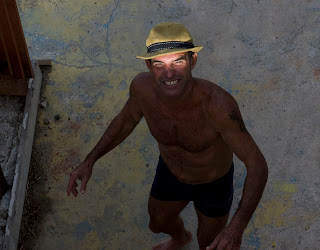 Henry. Henry.
We left soon.
Click here for more photos.
Fred & Judy, SV Wings, Curacao Labels: Caribbean, Curacao, judy, Santa Cruz Baai
June 27, 2013-Turning a Corner
wingssail images-fredrick roswold
 Curacao Curacao
Curacao: a hot, dry and windswept island of sun, sand and cactus. To get here you run downwind from the eastern Caribbean Islands for days and in the strong trade winds, like we’ve been having, there is no going back (some rugged sailors have done so; my hat is off to them).
It is a place which seems far away from anywhere. Its sister islands, Aruba, and Bonaire, seem similarly remote from the rest of the Caribbean, out here in the sea by themselves. Maybe Far Tortuga is out here somewhere.
In reality though, the ABC’s aren’t remote and alone. There are other islands nearby, though you can’t see them, and the South America coast, Venezuela, is only 35 miles away. So even though it seems remote and desolate, it isn’t really. And there are people, lots of them, and cars and boats, and houses. Still, maybe it’s just the endless howling of the wind and the often empty streets that make it seem so, but we half expect to see tumbleweeds to come flying across the road.
Other than this feeling of remoteness, I find Curacao interesting for some other reasons. It is heavily populated and there is evidence of money. The houses are big and nice looking, on lots with high walls, and they have double car garages, but the residents themselves remain hidden from view, giving the place the air of a rich ghost town. Where does the money come from I wonder? These homes are retirement homes for people from Holland, I was told, so maybe that’s it.
And the geography is interesting. While so many islands in the Caribbean have no protected ports, Curacao has many. We are anchored in one, Spanish Waters; an inland bay completely protected from the sea, surrounded by nice homes and moored boats. And St. Anna Bay, around which Willemstad, the capital, is built, leads inland like a canal to the Schottegat, the vast natural harbor filled with container terminals, docks, and shipyards. There are other harbors, Fuki Baai, Piscadera Baai, and Santa Martha Lagoon; all accessible from the sea but fully enclosed with deep water inside. What geological conditions produced this place?
The value of these harbors was recognized early on by the Spanish, Dutch, and English, who all fought to own this island. The Dutch won in the end and Willemstad was built by the Dutch 400 years ago and quickly became an important shipping port and the center of the African slave trade as well as a hub for piracy. These activities brought wealth to Curacao. Though the slave trade and the pirates are long gone, Willemstad has remained one of the Caribbean’s important cities. Today it is a world heritage site, richly cosmopolitan and valued for its Dutch colonial architecture and its history as well as the busy port. We have enjoyed walking Willemstad’s narrow streets, having meals in its quaint café’s and relaxing by the waterfront drinking cold Heineken beers.
But for us, Curacao is the end of the Caribbean. When we leave here, or when we leave Aruba, our last Caribbean island stop, we’ll go into to a new world: Latin America.
 Chart of the Caribbean. Chart of the Caribbean.
Click here for an explanation of the chart.
We’ve come westward 500 miles across the Caribbean Sea towards these islands where we are now, well away from the beaten cruiser paths of the eastern Caribbean, and each mile we’ve come has been windier, rougher, and seemingly more remote from one before it, but we are about at the limit. Soon we’ll sail over the top of South America, past one of the windier places in the world, the Peninsula de la Gaujira, and we’ll turn a corner, out of the Caribbean where we’ve spent the last 15 months, and into the Columbia Basin, where the winds will go lighter, the seas calmer, and the culture will be Latin American salsa instead of Caribbean reggae.
We will have turned a corner and turned a page.
We are ready for it.
Click here for more photos.
Fred & Judy, SV Wings, Curacao
Labels: ABC'S, Caribbean, Curacao
June 23, 2013-Curaçao
wingssail images-fredrick roswold
 Curaçao. Curaçao.
There are a few sunburned and wizened old single handers here, mostly Dutch.
"The bus driver doesn't like us." Dick said.
"Why?" I asked. We were hanging out on his boat, a catamaran with barnacles creeping up the side. He's been here for nine years.
"Because we're Dutch." His buddy Haus nodded.
"I don't get it, doesn't Holland put heaps of money into this country?"
"Yeah, but we were the slave owners 200 years ago." he answered.
So that's the story of Curaçao:
The Dutch built this place, brought in slaves, and now, 200 years later, there is still resentment over that fact.
Understandable, I guess.
The truth is that the Dutch own this island, support it, and in the background, hold it standing upright, but the coloreds simmer.
They always will.
We've been here only a few days, but the underlying tensions are evident. Never mind that, what about from our perspective?
Well, Curaçao is old, and beautiful. And we love it.
Discovered by the Spanish in 1502, Curaçao had a great harbor, one of the best in the world, still does, and it was a natural hub for shipping trade in the southern Caribbean. The island was occupied by the Dutch in 1634 and the Dutch West India Company made Curaçao a centre for the Atlantic slave trade in 1662. That and piracy flourished here for a few hundred years bringing wealth to Curaçao and Holland. The capitol city of Willemstad, with its attractive Dutch and Latin American architecture, still stands, as does the legacy of Dutch rule over the larger black population.
And that is what Dick was alluding to when we told me that the blacks resent the Dutch.
What we noticed while travelling around Curaçao is that while the Dutch own the place, the blacks and, equally, the Venezuelans, run the place. They give it the feel on the streets and in the shops, and it is they whom you will be dealing with as you travel around the island.
And that part we are OK with. In fact we love the Latin American feel of Curaçao.
We just don't like the sullenness we experience sometimes.
But I guess we can't blame them.
Click here for more photos of Curaçao.
Fred & Judy, SV Wings, Curaçao
Labels: Caribbean, Curacao, Willemstad
NEXT Page (More)
|


.jpg)

