December 12, 2020-Making the Red Dragon
wingssail images-fredrick roswold
 The Dragon
Sometimes we get these ideas that are really dumb. We don’t
exactly know where they come from and if we’re smart we just let them pass.
But when Luis pulled the Red Dragon out of the bag onto the
grass I was inspired, I had to have that spinnaker. It was so…stunning.
But it was a dumb idea.
Who in God’s name needs a 2.2 oz blood red symmetrical
spinnaker with a giant dragon on it. Especially since we never have the kind of strong winds here in Mexico where you would need such a sail, and if we did have
those kind of winds we wouldn’t be flying a spinnaker, and anyhow I already
have a heavy duty symmetrical spinnaker, which is also nearly new.
And what’s with the red color and the Chinese dragon? I have
no connection with China.
But this sail was so beautiful! And, while second hand, it
was apparently unused (no surprise, who would ever use it?). And the price was right, very right. Oh I
wanted that sail.
Then I had an inspiration: What I did need was a heavy duty
asymmetrical spinnaker to fly on those windy reaches we have here so often. Why
not recut this sail into an asymmetrical? With its weight it would be
bullet-proof.
So I bought it.
Now recutting a symmetrical spinnaker into an asymmetrical
might be a bit tricky I thought, especially if I want it to work well enough for racing, and what
did I know of such things? Nothing.
But no harm in trying, and actually, I was sure it would turnout all right, I never believe that things won't turn out OK when I start a project. I just plow into them, you could call it over confidence. Any anyhow, if it doesn’t work, Luis wants it back to make
kites out of it. I’ve got nothing to lose.
First we had to take a look at it. We got some of the crew one day and went out to put it up and see what shape it had.
 The Dragon, in symmetrical form
Everybody likes it
It was big and a bit flat (OK) and it had narrow shoulders
(also OK) and a narrow head (also OK, really OK). It was also pretty. I took
some photos. Now I was really encouraged.
Back home I did some research into asymmetrical spinnaker
dimensions, and played around with Photoshop until I could create an image of
what it would look like as an asymmetrical.
 Cut out on the white lines
Next Judy and I hauled it and the Sailrite sewing machine up
to the VIP room and tore into it. We measured and cut and taped and sewed.
Seven hours later we had an asymmetrical. Retaining the dragon logo in the
middle made the job a little trickier, but I found a way around that.
 Sewing
Now to try it out.
We were scheduled to sail on in the Beer Can Race on
Wednesday so when the crew arrived I told them we were going to again use the
Dragon, but now it was an asymmetrical. They shrugged, “Whatever you say,
Fred.”
But it worked!
 Terry sets the Dragon, asymmetrical mode
Oh I saw some flaws and the leech needed some re-shaping,
and we had trouble jibing it, but it definitely worked as an asymmetrical. The
crew thought it was fine.
Back in the “loft” for a second re-cut. This required less
time.
And back on the boat for the next Wednesday’s race we gave
the dragon a real workout. We still had trouble jibing, but the sail worked
even if my steering didn’t. After the race, in which we were last, we went back
upwind for more practice. We got the jibes sorted out. Then we decided to see
what that sail could do.
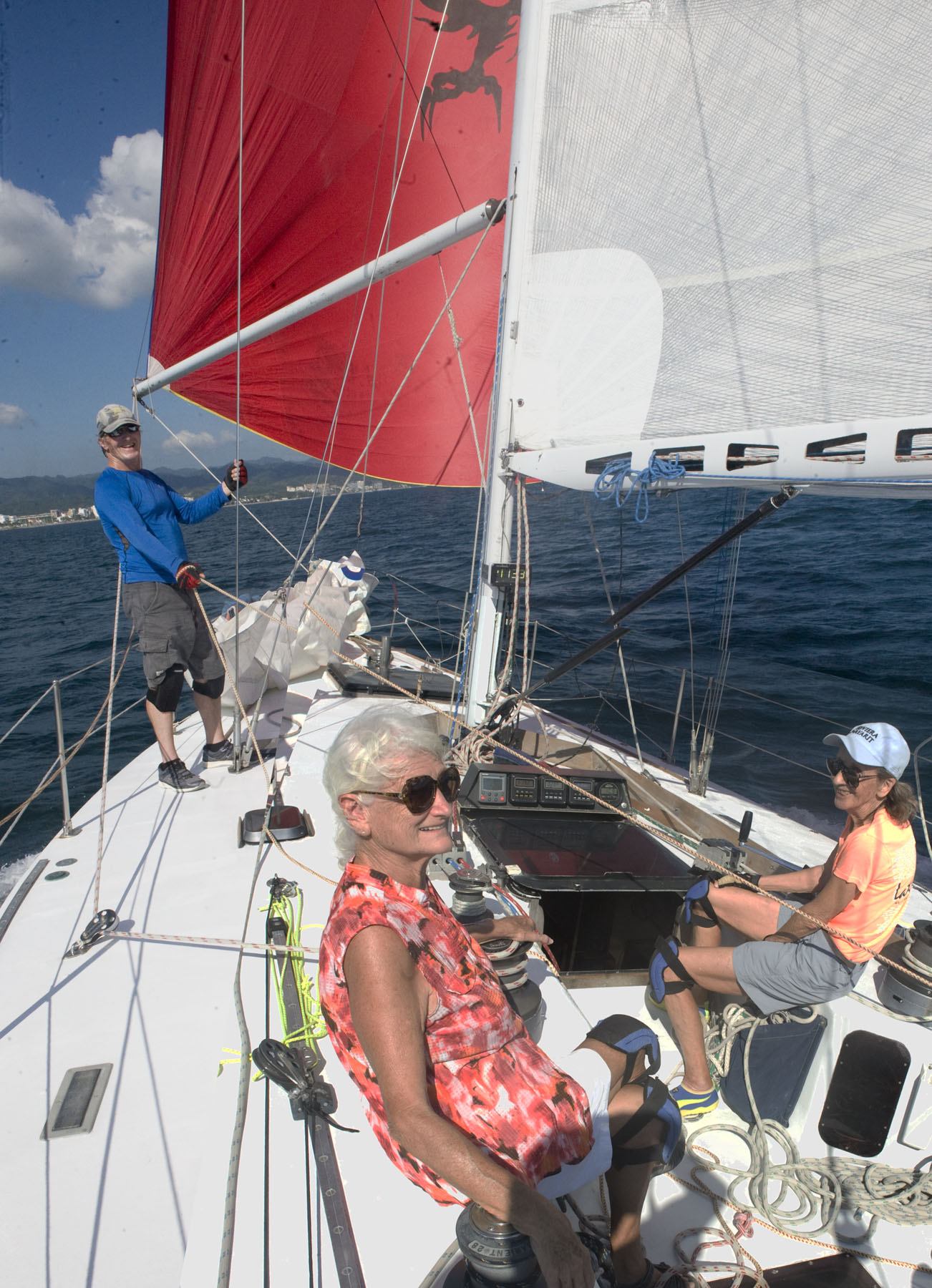
In 15 knots of wind we came up onto a reach. No problem.
Then a tighter reach. Still no problem.
Then a really tight reach. Apparent wind at about 45
degrees. WOW! 
Flat Sail, Hard Reaching
That Dragon transformed itself. Downwind it was full but when
strapped tight it became flat. It really was gorgeous! And the power was
forward, where it was needed. Wing’s rudder had no problems holding that sail
in that wind, It was Fun! Everyone was grinning. What power, what speed!
 Hard Reaching Fun
So we don’t know if it will really be fast (compared to
other boats, I mean) but we’ll find out soon enough, and in the meantime, we
had some real fun doing it.
Sometimes dumb ideas work out.
Fred & Judy, SV Wings, La Cruz Huanacaxtle, Mexico
PS. Where did this sail come from?
There was a boat here for a few years with an absentee
owner. He’d gone to China, apparently (funny, so there was a China connection
with this sail) and some say he met a girl there and wasn’t coming back. He
stopped paying his berthing fees, we were told, He also stopped paying Luis to
maintain the boat.
“Sell the sails and get your money that way.” He wrote to
Luis.
Then the marina foreclosed on the boat and sold it, but Luis
still had the sails. I helped Luis flog the sails and when it came to the red
one, he gave me a good price.
windcharmer images-don deil
 Coming In Click here for more images. Fred & Judy, SV Wings, La Cruz, Mexico
Labels: boat work, Mexico, sailing, Sails
October 29, 2016-Changing Seasons
wingssail images-nick white
 Reaching with the new kite Reaching with the new kite
October in Banderas Bay brings the change of season. September is still summer and is hot and sweaty. We continue to swelter even into October but the nights start to cool down and by the end of the month the seasonal change is upon us; the cool and wonderful winter weather is just around the corner.
The other change which happens in October is that we start to convert Wings back to a racing boat.
During this last summer we did a lot of work to complete our project list; amazingly we got them all done, but at the end of it we were still a cruising boat. All the cruising equipment was still fitted and we had our cruising sails on board; that wouldn’t do on the race course. The racing season is almost upon us so we must hurry to get the boat ready for the competitive season. It’s time to get down and dirty.
First, the annual haulout: One Friday morning in mid October we took the boat over to the La Cruz Shipyard and Alexandro’s crew placed the slings under us and lifted us out of the water. Because we wanted to take the rudder out for a bearing replacement I stayed aboard while the travel lift had us up in the air to unbolt and drop the rudder. That was a first for me, being on the boat while it was in the slings, but it went smoothly and we lowered the rudder out before setting the boat down on the stands. When they finally placed a ladder against the hull and I could climb down the rudder was on the ground and the workers were already sanding.
wingssail images-fredrick roswold
 Looking up the rabbit hole Looking up the rabbit hole
 What a pretty bearing What a pretty bearing
Doing the thru-hull replacements was hard but after a few hot and sweaty hours with both of us slithering around together in tight places getting knuckles skinned and muscles strained the job was done. The rudder bearing replacement also went reasonably smoothly, other than the difficulty of getting the old bearing out and other than the doing final fit of the new bearing. I expected to get the old bearing out by simply sliding it down. Instead I found it completely stuck and I spent several very hot and exhausting hours with a 4lb sledge in one hand and a chisel in the other banging over my head trying to cut it out. In the end I was knackered and it still wasn’t out. I asked the boat workers to finish the job for me and Judy and I retreated to the coolness of the La Cruz Inn.
By next morning the bearing was out and I took my measurements and ordered a new one. Unfortunately we couldn’t test the exact fit of the new bearing until I could work the rudder and bearing assembly back up into the boat, and that required the boat to be lifted again for the return trip to the water. Then we found it didn’t fit as well as we’d hoped: it was a little loose, better than the one we took out, but not perfect. We decided to go with it. To halt the project at that point and get another new bearing made would almost double the cost and time of the whole project, and besides, we weren’t sure how it would feel when we went sailing. Maybe it would be OK.
We launched on October 19th and spent a few days cleaning and putting racing sails on board.
On the 25th we collected some crew and went sailing. The main goal was to test the new sails, test the rudder, and see how everything worked.
 Ahh, Carbon Fiber Flat Ahh, Carbon Fiber Flat
I have to say that the sail testing trip was a complete success. The weather was perfect for a light #1 and after an hour the wind increased enough to test the #2. We put new marks on the deck for the jib cars for both sails. We sailed back to the marina with the new S3 1.5 oz spinnaker and it reaches like a bandit.
The sails looked good and the rudder was smooth although we still won’t know for sure about it until we get into some heavy weather upwind work and we don’t know when that will occur. For now it’s fine. Everything else, with the exception of the new halyards, worked perfectly.
The only problem we had was that the new Dyneema halyards seemed to creep or slip. This was not totally unexpected but it was still disturbing that after a few minutes of sailing the luffs of both the main and jib seemed to slack off a bit. Mike warned us about that and it seems he was right. We’ll work on pre-stretching them a bit, which he said would be needed.
All in all we had a great sail and we are totally pleased with all the work done and the new sails. By the end of the day when we sailed back into the La Cruz Marina we were all hot and tired from a day on the water but very happy. We are looking forward to the new racing season.
Click here to see tons more photos.
Fred & Judy, SV Wings, La Cruz Huancaxtle
Labels: boat work, Mexico, Sails
October 15, 2016-Round Up-Update
 New Spinnaker hits the loft floor for measurement and numbers New Spinnaker hits the loft floor for measurement and numbers
The saga continues:
John flew into town on Tuesday with our new spinnaker in his luggage, only his luggage didn't arrive with him. The spinnaker went to Los Angeles.
DANG!
But Alaska airlines assured us that they'd collect the missing bag and deliver it to the marina on Thursday, which they did. So now we have it.
WOW! it is a very nice kite. We hauled it up to Mike's place for a measurement and a change in numbers. Mike says he will get us the original builder's certificate, all part of the great North Sails service. WOW again!
Now everything we have been trying to collect from the US has gotten here, Spinnaker, BBQ, Mail, boat parts.
It's like Christmas, early.
Next we'll put the boat in the yard and do the bottom, get the new rudder bearings, do a couple of through-hull fittings, and be back in the water by Tuesday or Weds next week, then we can go sailing with the new sails. That will be fun.
Fred & Judy, SV Wings, La Cruz Huancaxtle Labels: boat work, Mexico, Sails, spinnaker
August 26, 2016-All About Mainsails

I made our first new mainsail in 1993.
 1993, Home-made, Kevlar mainsail 1993, Home-made, Kevlar mainsail
I wasn’t a sail maker and I didn’t have clue about what I was doing, but I did it anyway.
I went to the library and checked out some books on sail shape. Library? Books? Yeah, I actually went to the Seattle Public Library in downtown Seattle and got some hard cover books. Can you believe that? Amazing! How yesterday! Then I wrote a Lotus 123 spread sheet to calculate the dimensions of each panel, there were 52 of them, based on the shapes I learned about in those books. That spreadsheet, wow, it was something (it got lost when a floppy disc failed years ago). With a design in hand I bought a Sailrite machine and a bunch of Kevlar and started sewing. I did it on the floor of the CYC yacht club. It took 80 hours. The sail turned out pretty good. It was dumb luck.
It caused a bit of a stir around Seattle; lots of people knew I was making it and when we showed up on the course with it there were quite a few eyeballs scoping it out. I don’t know if they were impressed or not, nobody said much about it, but they paid attention, I can tell you that.
There was a lot that was experimental about that sail, from the particular Kevlar and polyester laminates I used, to the graphite tapered round battens I made which had a habit of exploding without warning, to the Lotus 123 graph I used to model and view the sail shape before I started cutting cloth. There were other problems which required endless repairs over the years but the basic sail shape was good. I have now come to believe it was very good although I didn’t know it at the time. It had a large roach and flat and smooth in midsections where it needed to be flat and smooth. The draft was about right, and there was plenty of twist aloft. The shape was a success. It was fast out of the box and we won a lot of races with it.
Thirteen years later, in 2006, that mainsail was shot. That is a pretty long run for a racing sail but most of the time during those years it didn’t see much use; we were cruising and the Dacron cruising sails were hoisted, not the Kevlar racing sails. Still, after 13 years, it was toast. It had patches on top of patches. I had neither the time nor place to make a new one but both Judy and I had jobs and were making good money, so we decided to buy a replacement.
We got the replacement, our second new mainsail, from Shenzen, China.
 2006 Main from CSF 2006 Main from CSF
There was a place there which our friend Jim Fernie told us about called China Sail Factory. China Sail Factory (CSF) made sails for sail lofts all around the world for a good price. The main they quoted was cheap enough so I ordered the sail, sent in the measurements and wire transferred the money. Some guy in New Zealand I never met or knew designed it. The sail arrived in Singapore soon afterward, as scheduled, but what a disappointment! The fabric and construction was beautiful but when we put it up I was horrified. The shape was bad. The sail was too deep aloft and the body wasn’t fair. Every seam looked like a ridge. The draft was all wrong. I didn’t see how we could win races with that sail but I was stuck with it. When you buy a sail over the Internet, from some factory in China, you don’t have much recourse if you don’t like it. Sail shapes are too subjective anyhow; they could just say it was fine, or fault my measurements. A recut was needed and again, I didn’t have the time or place to do it. I couldn’t do it. So we sent the sail to a friend in Perth with specific instructions for what we wanted and when it came back it was better. Not good, but better.
We used that sail, actually we had no choice, and in time we forgot about the shortcomings. Maybe the sail even got better as we used it. We also found that with skillful trimming we could make the shape acceptable. And we did win with it too. We were dominant in King’s Cup in 2006, and we used it all over the Asian region. Years later, in Colombia in 2014, it was still reasonably good and in 2016, 10 years after we bought it, we were still using it in Mexico and still winning races. In fact it seemed that the older it got the better it looked.
But 2016: that was the end of Mainsail #2.
At the finish line of the second race of the Banderas Bay Regatta that year our China-made Kevlar main totally disintegrated. There was a hole in the middle of it big enough to walk through.
 Trash Trash
We put up the Dacron cruising main and finished the regatta but we needed another new mainsail if we were going to keep racing.
So, what to do for a third new mainsail?
We went back to China Sail Factory, for price mainly, but I also thought I could have more control over the design, and I had some ideas about what I wanted. We had several email discussions with the designers in Shenzen, the CSF designers, and in the end they agreed to my ideas and they built the sail I wanted. You can see it here on the right.
 Old and New Sails from China Sail Factory Old and New Sails from China Sail Factory
It's not perfect, but it's better. It is a much flatter sail than the last one, more like the 1993 sail, but a little less roach. That reduced roach was an accident; I wanted more roach but I failed to communicate it properly. Anyhow, we didn’t get the extra roach. Otherwise the sail is beautiful. It has the same flatness and smoothness, more so even than my 1993 sail. Oh, we have some minor issues with the top, and we’ve only had it up once, but all in all it is probably the best mainsail we have ever had for this boat.
It is interesting to compare the photos of these three sails. Even an untrained eye can see the differences. We are really interested in seeing how we perform with this newest sail. In 1993, with the one I made back then, we had the best racing season ever with Wings. What will we have in 2017?
Fred & Judy, SV wings, La Cruz Huancaxtle
Labels: boat work, mainsail, Mexico, Sails
July 23, 2016-New Generation of Sails
wingssail images-fredrick roswold
 New Main New Main
Sails don't last forever. Neither do sailors.
But while we can't do too much about our aging bodies, at least when our sails wear out we can replace them.
In March we reported that our Kevlar mainsail was finished. In the Banderas Bay Regatta it finally self destructed with a hole up the middle big enough to walk through. It could not be repaired. The genoa was not far behind it. We had been expecting this for some time but even so, it was not welcome. We loved these golden racing sails which we've been using since 2007. We knew that if we were going to continue racing we needed to get new sails, but they would cost us plenty. Too much in fact.
So the hunt began for an affordable solution. Here is a progress report:
We found a used genoa in California that matched our boat, not quite big enough to be a #1 but it would be a great a #2. It was old but it was a good North kevlar tri-radial in very good shape, and best of all, it was inexpensive. We bought it and had it shipped to Mexico.
We found an unfinished mainsail at a sail loft which a customer could not take and which was available. It could be finished for us and would fit pretty well. This too was a very good price. We bought this sail and had it finished to our specification and shipped to San Diego where we picked it up.
A friend from the old days in Seattle told us he had a good (nearly new, used in only one race) heavy duty spinnaker which he wanted to get out of his garage. The price for that was too good pass up so we bought that too. We haven't gotten it yet, but it's coming.
Replacing our racing genoa proved to be the hardest problem to solve. No used sails could be found. New ones were going to be very costly. We've been working with several sailmakers, trying to find an affordable solution, and we're getting close, but we still don't have a new #1 genoa.
And the #3, which is also pretty trashed, will just have to wait. There is a limit to what we can do.
Meanwhile, we've gotten the mainsail and the #2 genoa and been sailing with them. They look good. The main is pretty close to perfect. The genoa was close but needed some work. We had it recut by Mike at PV Sailing and we know it will be a good sail for as long at it lasts. Old Kevlar sails don't have a very long life, but we know we'll get our money's worth out of it, it was cheap.
By the time the racing starts again in December we should be in fairly good shape; we'll have a whole new generation of sails. We also have quite a few other projects going on this summer. Besides the sails we're replacing a lot of our rigging, including all the wire halyards, we're repairing some damage to the deck, we'll have new rudder bearings, and we're repainting the main cabin...the list goes on.
Altogether it's a big project list this summer and this is not the first big project we've done on this boat. It's about the 5th. It won't be the last. Boats, especially racing boats, require constant maintenance but we'll keep doing it and try to keep Wings in good shape. Wings pays us back by giving us a comfortable home and great sailing days like this:
image-rick taylor
 Wings sailing with new sails on Banderas Bay Wings sailing with new sails on Banderas Bay
And you know what, great days of sailing like this do wonders for rejuvenating old bodies too.
Fred & Judy, SV Wings, La Cruz Huanacaxtle
Labels: Banderas Bay, boat work, Mexico, sailing, Sails
March 16, 2016-Sail Damage
wingssail images-fredrick roswold
 Mainsail Repair Mainsail Repair
Racing sails have a limited lifetime. We know that. It’s been said they will last three years, and ours are eight years old, a long time for a Kevlar/Mylar sail even if they haven’t been used much over 5 seasons. Last season I wasn’t happy with the shape but I thought the cloth was OK. The problem is that the Mylar shrinks and gets brittle. But still, we’ve been hoping ours would hang in there. The replacement cost is prohibitive. New laminated racing sails go for $5,000 to $10,000 each. We can’t even think about that.
Boy was I wrong about them lasting. We had them in the loft for a couple of months and did some reshaping, and that’s when we noticed the Mylar was breaking down. We slapped a bunch of high tech tape on and wondered if we’d get through the season.
Well, the reshaping worked. Those old sails were faster than ever, but right away this season we started to have failures: holes appeared in the panels, cracks showed up on the edges, and seams started to pull out. I was repairing sails after almost every race. The handwriting was on the wall, we’d need new sails, sooner rather than later, at least a mainsail and a genoa.
I got a lot of quotes for new sails. No surprise, we couldn’t afford them. We bought more repair material and spent more time patching them.
No dice, they were toast.
The genoa and the main got to where they looked like they would blow up the next time we used them. I saw a used genoa sail listed at Minney’s, a used sail store in California. It was 18 years old but barely used and the price was right, $347.00. A sail maker went over there and checked it out. “Nice sail”, he said, and it would fit Wings. Surprisingly the Mylar was still good. We bought it and had it shipped to La Cruz and put away the old genoa we’ve had since 2007. Then the #3 jib blew up, disastrously; tore in half with a pop. That was a shocker since that sail was barely used, but I had been worried about it; the cloth seemed tired. We got it fixed but we have no faith in it. Finally the mainsail, shown here, completely disintegrated. We had already started using the Dacron cruising main for practices but we wanted the racing main for the Banderas Bay Regatta. I spent another evening slapping tape on it and sewing. We went out for the first day of Banderas Bay Regatta flying that main. It lasted to the end of the race, and then ten minutes later it disintegrated.
Well, that’s racing.
We will somehow find some replacement sails and be ready for next year.
I wonder how many times we’ll have to go through this.
john pounder - jldigitalmedia
 Remembering the golden sails We won races in Singapore, Thailand (King's Cup), the Caribbean, and Mexico with these sails. They have been great. Remembering the golden sails We won races in Singapore, Thailand (King's Cup), the Caribbean, and Mexico with these sails. They have been great.
Click here for a couple more shots of the sail repairs.
Fred & Judy, SV Wings
Labels: boat work, Mexico, Sails
NEXT Page (More)
|


.jpg)


