July 1, 2026-Spring Cruise and Adventures in the Sea of Cortez
BANDERAS BAY REGATTA
The wind was up and the line was crowded but we weren’t afraid. Yes, the big boats were out in force: five boats in the start ahead of us, five in our start, and nine in the start behind. All together nine out of 19 were bigger than us, and supposedly faster.
So what?
Third week in March was the Banderas Bay Regatta, out of the Vallarta Yacht Club, and we sent it. Why not? The crew, a great crew, was ready, the boat was ready and we were excited.
swanFun images
And the racing was good. Three races and the wind never stopped. We won the first two. Our biggest competition was Swan Fun and they were tough but we got them. But they got us, both Swan Fun and the wind on the third day when we tried to carry the kite on a tight 20kt reach. We were over powered and kept rounding up. (What? No pictures? Who’s taking photos when you’re trying to survive). Swan Fun made the perfect call: At the jibe they dropped the kite and finished with a small jib. By the time we got our kite down they were long gone. I wish I know who made that call, it was brilliant. Was it Joe?
But we won the regatta, and being first on the podium felt really good.
GOING CRUISING TO SEA OF CORTEZ
But immediately after the BBR Sandy and I got back to work getting ready to cruise to the Sear of Cortez.
It was hard work and we didn’t have much time. It’s been like that since November: we work like hell to get ready for a race, then we race as hard as we can, then work like hell to get ready to go cruising. Rinse and repeat. That was the racing season. We had 23 races and two multi-day offshore deliveries jammed into four months.
Sandy In the Dingy
Then we headed off for a three month cruise and that wasn’t any vacation. In fact the cruise was another 12 weeks or frenetic work: sailing every day, changing crew every few weeks, new problems every day that needed to be fixed and finally sailing back to La Cruz with an injured crew.
Crossing to Baja was mostly motoring but it wasn’t trouble free. We broke a fan belt and discovered a broken bolt on the alternator bracket, which we drilled out while sailing (fun). And the AIS was found not to be transmitting (it received, we could see the ships, they couldn’t see us) and a handful of other issues. But we got to La Paz. Yay!
The big issues were still to come.
The two problems which really hit us early in April hard were a complete failure of the dingy and complete failure of the refrigerator.
The dingy went first. A big woosh and air tubes split open. The dingy went suddenly flat. We tried to repair them but it didn’t work. It would hold air, briefly. We took a pump everywhere. The dingy could be used but not trusted. Crew were coming for further cruising but how could we continue cruising without a reliable dingy?
But then another problem cropped up: the refrigerator stopped working. Completely.
THE SAGA OF THE $5000 REFRIGERATOR REPAIR
On a boat, most boats anyway, the refrigerator is taken for granted. It keeps beverages cold, and veggies fresh, but most of all, it keeps meat frozen. Some salty sailors living it rough go without refrigeration but the guests I had coming were not expecting to live that rough. I never told anyone when they signed up that we wouldn’t have a refrigerator. Without refrigeration it made the possibility of enjoying a cruise for three more months pretty much unthinkable. At least that’s the way I looked at it. So I went shopping, online.
Compressor units for my fridge were hard to find. But after a lot or Internet research, I finally found one, only one. Not in Mexico. It was in California. West Marine had one. But it would take two to three weeks to ship it to Mexico. No Bueno. I had guests arriving and anyhow, I couldn’t stay in the marina for that long. But Mike and Judy from Honu lived nearby the West Marine store and could go and pick it up. Then they were flying to La Cruz in four days; that might work. I called them. Done! It was small and they could bring it in their luggage.
But wait, Wings was in Puerto Escondido, 500 miles from La Cruz.
No problem, Sandy and I would just fly to La Cruz and bring the refer back. So we booked tickets, round trip. It took five separate flights but we could do it. And while we were there we could attend the annual Yelapa trip for Mike Danielson’s memory.
John agreed to take us to Yelapa on Edwina.
This would be a holiday.
We thought.
Off to la Cruz we went by air. Checked into Hotel Edwina. Sailed to Yelapa and back, had a good time. Got ready to take the refer back to Wings, which was still in Baja.
But wait! We missed our flights and our connections!
At the ticket counter the lady said, “No Sir, you missed your flight. No more flights until tomorrow.”
How does that happen? I got the date wrong. Oh Shit!
So that was three flights, for two people, that we trashed. And a couple of unplanned hotel stays. Money!
Well we bought new tickets and boarded the plane the next day. We got to Tijuana, where we were supposed to make a connecting flight to Loretto. (By the way, I want to point out that Sandy had an International flight to catch from Loretto to Charlott South Carolina the next day and Dulce Marie, my next crew, was flying in. Things were getting tight.)
“I’m sorry sir, you cannot take that compressor on our aircraft, No way.”
We couldn’t fly. Another two tickets trashed. More Money!
Well Damn! What do we do now? We’re in Tiajuana Mexico with a refrigerator compressor and need to be in Loretto the next day and can’t fly.
Sandy said, “We should rent a car.”
So, we got a car for a one way car rental to Lorretto, extra fee, $1500 USD. Even more Money!!
The drive from Tiajuana Mexico to Loretto in Baja is 14 hours. It was hell. We left Tiajuana at 3:30 PM and drove all night. It was really hell. Two lane road not well marked. Big danger of northbound trucks roaring out of the darkness with lights blazing. God, I don’t know how we made, it. We should have died but we didn’t.
Sandy
Sandy made her flight to South Carolina, I met Dulce Marie who came into Loretto at the same time, and I got the refer compressor to Wings. The new compressor worked! It all worked, but it cost me, all up, $5000. Dang!
Another crew change in La Paz. Dulce helped my find a new dingy then she flew out and Kelsey came in. The month with Kelsey was good. Lots of sailing and few boat problems. Then she left and Rene joined.
Oh yeah, Rene and I continued to find a few little boat problems, but not until the middle of June did things go really wrong again. On Monday the 15th of June, while we were anchored in La Paz charging batteries with the engine the alternator shorted out and caught fire. We caught it right away and shut down the electrical system, but the damage was done. The alternator was ruined and quite lot of wiring nearby was burned or melted. It could have been worse. We replaced the alternator with a spare and put in new wires and were good to go. Wow, was that close!
From Baja Rene and I crossed to Topolobampo on the mainland side and sailed up the long shipping channel into that neat little town. I’d been there before and pointed out all the familiar landmarks and anchorages and we navigated that tricky last little channel to the marina without any issues. Yay!
Topolobampo was fun. We walked everywhere. We even took an uber to Los Mochis that week for shopping, bought some fan belts for the engine and had a great lunch, very Mexican. But sailing out after four days later was challenging. The onshore breeze filled and got stronger as we tacked out of the channel and we had slow progress going from buoy to buoy as the wind, waves and current against us made it a slog. We reefed the main. We watched the depths whenever we approached the side of the channel. We had to stay high, and the windvane couldn’t do it. I took off the windvane and steered.
Finally we reached the outer marker on port tack and felt we had enough sea room to tack onto starboard and head south. But the Sea of Cortez wasn’t done with us.
I called out, “Ready to tack?”
“Ready” answered Rene on the jib sheets.
“Tacking”, and I put the helm down.
Wings swung its head through the wind and then stopped for a second. We had flown off a wave then hit the next one head on and it jolted us. Rene was just turning to tail the new jib sheet and she was thrown forward towards the open hatch and landed on her back against the corner of the hatch opening. I heard a shriek and looked to see her lying next to the winch. The jib was flapping.
I said, not knowing she was hurt, “Pull in the jib”.
But Rene couldn’t move. She couldn’t even breathe.
“I think my rib is broken”, she said when got her breath back.
Oh fuck!
Now what? Turn and go back to Topolobampo? It was 15 miles in rough conditions and not easy to do singlehanded. And what then? There didn’t seem be any medical facilities in Topolobampo. We’d have to take a long taxi or uber ride to Los Mochis. For what?
Keep on course to Mazatlan? That was 205 miles to the south, but it was easy sailing, open water and no hazards. Rene thought we should go to Mazatlan. I sent her below to rest and began single handing south.
Rene felt she would survive and that she could do a little to help sail the boa, at least stand watch when I had to sleep. We sailed onward.
This episode brought back to reality something I’ve known forever but never really faced before: When you go to sea in a small boat you are playing for keeps. Rene broke a rib. She could have been killed. Or I could have been killed or thrown off the boat. There is no doctor out there, no rescue services, not even a Coast Guard to call.
But none of those things happened. They haven’t happened to me in 50 years of sailing. We get complacent. But the danger is out there, just waiting.
THE FINAL LEG BACK TO LA CRUZ
Sailing was easy from then on. We spent long days making great time broad reaching towards Mazatlán and nights motoring. It was good for Rene who needed to rest and let her rib stop hurting a bit.
By the time we anchored in Mazatlán’s old harbor we could breath a little. We were close to home.
We were hitting speeds in the high sixes going upwind with 25 knots of wind and big seas and the ride was pretty bad. It would be nice to slow down but Wings, sailing to windward in a strong breeze, doesn’t know slow. Puttin up a small headsail and putting in a reef in the main makes no difference; still too fast. We flew off of wave after wave and landing was like hitting concrete. The noise was deafening. The bow tossed up ocean water like someone throwing buckets, only lots more. The wind then carried it back and it landed on the dock in rivers. The whole boat was continuously covered with salt water. Down below conditions were not so bad but after a day or so things started getting wet there too.
And the pounding continued.
Mp4 102 Rene Stands Watch on the Crossing (to see this video try clicking on the heading and then maybe click "replay")
I knew the boat was strong and over the years I’d been through this before but after a while you just wonder how the hull and rig can keep taking it. But what to do? We really had to go upwind; we were crossing the Sea of Cortez going to La Paz and the route was up wind. So we just kept going, hoping it would be over. Resting down below or on deck huddling behind the dodger we just sat there taking a beating. Rene was stoic and I was glad for her experience and calmness but I was anxious and jumpy.
We tolerated it for two days
Finally I said to Rene, “Let’s try heaving to.”
“OK”
Hove too we were basically stopped, there was no slamming and no noise.
Hove to the boat became quiet and calm. Don’t let anyone tell you a race boat can’t heave to. It can.
We began to relax: “This is nice!”
We resumed sailing the next day and the wind continued.
It was more of the same tough conditions. We hove too again the next night.
By the fifth day we had battled our way across the Sea of Cortez and we anchored in Baja at Los Frailies.
Well that was an quite an experience but it was over.
For the next month Rene and I explored Baja and it was much nicer. After Rene four other great crew members joined me, one by one, and helped me sail. It was fun. In the months after rough crossing there was some great cruising with weeks of sailing every day between the islands and many pleasant nights anchored in quiet harbors.
Mp4 108 Tacking San Jose Channel (to see this video try clicking on the heading and then maybe click "replay")
There were even some overnighters when Dulce and I found ourselves becalmed in the middle of the Sea of Cortez for hours on end but we kept sailing and kept the boat moving. Dulce became a pretty good light air sailor, she had to.
Three months later, on the trip home though, there was more tough sailing. Kelly and I found ourselves in a big squall which ripped the mainsail in half (more on this later) but we survived.
So, that’s sailing I guess.
Boat Work
There were also projects and repairs. Things like starters burning out and leaking water tanks which were wake up calls and needed immediate attention.
Small repairs kept us busy also.
The new dodger
And then there was the dodger. I’ve made dodgers for Wings a few times over the years and the one I made in in Trinidad in 2013 was looking pretty ragged. We were lucky the heavy weather on the way up the Sea didn’t blow it out. Making a new one seemed like a good project to do when I had a few days alone in La Paz after Rene left. I got out my roll of white acrylic cloth and started cutting and sewing. I sweated and worked and made an ungodly mess with cuttings and threads and tools all over the boat. I was glad there was no crew aboard to have to deal with the mess.
For much of the trip we had a big problem with the propellor shaft and had to sail everywhere. The engine was basically useless even though we worked on it every day. When I returned the boat to La Cruz it immediately went into the boat yard for major repairs.
Living in Close Quarters
“What? No door on the toilet? Really? Will you please go on deck for a while? I need some privacy. And maybe you could put on some music.”
I had five crew members on board on this trip. Four single women and one guy, Kelly, who is one of my best friends. They all came individually. The women who dared to venture into this unknown liveaboard sailing thing were all pretty brave individuals, and trusting I guess, because they were going to be alone with me on this small boat and three of them had never met me before. But it worked out. It’s not just the toilet. There are no private quarters and no doors anywhere. Living in close quarters like this on a stripped-out race boat with a total stranger takes some getting used to. We shared the main cabin, changed clothes behind a partition, and everybody got the privacy they needed. We all tolerated each other’s quirks, and if anybody got on anybody’s nerves they never let it show. In any case it all went pretty smoothly.
About the toilet: Well, I told them about that before they signed up but it was still pretty shocking I guess. For the people joining me for the first time to live on Wings for a few weeks it was quite an experience.
Me? I had no problem? I enjoyed it all including the domestic stuff like sharing cooking and cleaning and choosing a wine together to have with dinner, I need the company. In fact I like it so well and am so used to it I think they are still there sleeping on the bunk across the cabin even after they have left. I wake up in the mornings surprised to find nobody there.
After Kallie the next crew change was scheduled in Loretto on the 17 of June and Dulce stepped off the bus right on time as the fourth crew member this year.
Dulce and I also had a lot of fun sailing around the Sea of Cortez including a few nights homeward bound when lack of wind and a broken motor left us sitting for hours.
Finally Dulce flew home from Mazatlán and Kelly arrived, after a grueling bus trip.
Terry had the worst time of it I think. When strong winds kept us hunkered down for several nights we didn’t get to go very far. But we made the best of it: we got to Puerto Balandra and went to the beach during the day for sunbathing and swimming and got back to the boat and got it closed up every night for the strong Coramel winds. If you know the right places to anchor 31 knots all night at is not a problem.
But probably the best thing for my crew was the sailing. Rene and Kelly were old hands but the other three were pretty new to sailing so there was really a lot to learn. It was one long class. At anchor I demonstrated their jobs to them and then we practiced.
And we practiced.
Things like raising the anchor and setting the sails got to be mundane, as did getting the dingy up and down. Even anchoring, which takes some skill and coordination, became ordinary. Charts were studied and navigation was taught. I added nothing that we didn’t need to do on our cruise, but we covered everything, even repairs.
Sailing however, was the real fun.
Putting sails up I work the foredeck and crew tail the halyards and use the autopilot to keep us head to wind.
“Are you ready?”
“Yes”
“Ok, right 10 degrees, then hoist.”
Sometimes it’s hard work and I was glad for my time in the gym the last few months.
Tacking or jibing I am usually steering and handling the mainsail and helping with the running backstays. Sometimes we traded jobs but usually the crew did everything else, releasing, winching and including running forward to skirt the jib.
“OK, Ready to tack?”, I would call.
“Ready”
“Tacking”
Then winches spin and sails fly and three or four jobs have to be completed in quick succession. We did it all. And we did it well. Some days we did it over and over. There were no bad tacks.
MP4 424 Approaching Nopolo
(to see this video try clicking on the heading and then maybe click "replay")
We sailed into tight anchorages and dropped sails on deck then secured them to prevent them from going overboard. Choosing the spot and setting anchor was the next challenge. My crews learned how to judge the bottom with their toe on the chain, how to tell when the anchor was holding and how to decide we were swell set. On their signal I would cut the engine and we would have a cold drink before the task of folding sails.
“It is time to start dinner or do I have time for a swim?” I think I heard that every day.
The Squall
After Dulce left my friend Kelly came for the trip from Mazatlán to La Cruz. I needed the experience he brought. The engine was basically useless and we had to sail out of Mazatlán harbor and of course all the rest of the way home.
We had some good wind and exited the harbor under sail without a problem but the season had changed and there were southerlies, so it was upwind work again.
About 03:30 in the morning I was below and Kelly was sailing close hauled on starboard tack in about 10 knots, using the windvane. The genoa was close hauled and the main boom was prevented out to port to keep it stable in the sort of lumpy seas.
“Hey Fred, something is going on with the wind”. I heard the call from my sleep.
Yep, something was going on all right, 30 knots hit us from the south east and knocked us right down on our starboard side, both sails aback.
I got on the helm, but what to do? I swung the boat around but close hauled on starboard, aside from being way over canvassed, took us to the NE. The other tack was pretty much west and neither was going to be good for the sails which were straining. Reefing the main would require going upwind and the genoa wouldn’t tolerate that, so it had to come down, not easy in this breeze, besides, which of us could go forward to hand the sail? It was one moment when I wished for roller furling.
We left the sails up as they were and I turned downwind. Kelly handled the sheets and I worked the runners and main. It was completely the wrong way to go but the flogging sails settled down and the boat came back under control. I steered by the Windex light at the top of the mast keeping the wind right behind us. Wings took off at 8 plus knots heading pretty much due north. We were glad we had sea room.
That was when the main let go. I heard a tear, then the sail unzipped from the leech to the luff, right across the middle.
Kelly said, “That is not a good sound to hear.”
We were still going 8 knots and steering was a handful. I couldn’t leave the helm and there wasn’t much Kelly could do either, so we just sailed, with the main in tatters.
Finally the wind moderated and I managed to get the windvane on and it took over the steering. Kelly and I went to work, untangling the mess, and put a reef in the main, just above the rip. Then we turned upwind and resumed sail to the south.
March 23, 2025- Banderas Bay regatta and thoughts about the future
wingssail images-vicki westphal
We’ve just finished another Banderas Bay Regatta, the eleventh one we’ve done on Wings since 1997. Last night we went to the Banderas Bay Regatta awards ceremony. We had some good sailing in this regatta (and a lot of hard work) but for the first time in the eleven times we have sailed it, since 1997, Wings was not on the podium. In the past we have typically been 1st or 2nd. Now this year we were forth out of 4 in our class; last place. It is disappointing. But all good things pass into history.
The question was asked, “Can you get back on top?”
Well maybe. It's partially about crew and partially about boat types.
This crew is getting better; they are good. But it takes years of experience to make really great sailors. This bunch will be ok with more practice and experience but even though I have some superstars I need a few more if I want to win. It’s tough to find superstars, and even keeping these people will be hard, some will move on to other things and others will decide the commitment and hard work is too much and I will have to rebuild. It would take two or three years to put together a really great team; we are on the way but it takes time. I know, I've done it before a few times.
Boat types is another challenge. In all three monohull classes this year the winning boats were modern, light weight, faster boats or much bigger boats. All were ones that reach better than Wings. The courses used by Vallarta Yacht Club favor lighter, reaching boats. If I am racing against similar boats, with a great crew, I can get back in top. Tenacatita this year proved that, we were dominant. But that was a different fleet, excellent pick-up-crew, and a course which didn't require fast reaching speeds. We also have one regatta here in the bay which is like that, the Blast, which occurs in December. We always win that. Last December we dominated it, winning by 20 mins in the second race. Wow! What fun.
For the other races the rating system could be changed that might help us older, slower boats, but there is little incentive for the yacht club to change it.
On top of it all it is hard work to keep this boat in racing shape and manage the program by myself. Harder each year as both myself and the boat ages. And expensive. For 38 years it was Judy and I. We were a good team. This year and last I have had crew who came to Vallarta and lived on the boat and helped do the work (a lot of it requires two people). Last year Rhonda was here a lot, she was wonderful. This year it has been Renee and she has been super also. These two women and some others have been close friends, not GF but friends, who were happy to come here and help. Mark, a very loyal crew member, has been a big help too. I have been very fortunate.
Since I have owned this boat I have raced it over 600 times, mostly winning or placing well, in addition to sailing around the world. Now I feel like I need to reassess my life. I will still sail but maybe a full-on, 26 race per year, program needs to be reconsidered. Is it worth it to carry on until the boat's glory years, and mine, are just a fading memory?
Now I will get to work for a week to convert back to a cruising boat and then go into the Sea of Cortez and relax for a few months. Rene, a great sailor who is another really good friend, is going with me for part of it and that will be fun. Then I see what life brings and how I feel about everything. One thing I know: this year was hard, more than anything getting and working up a crew. The boat is hard to sail competitively and these guys from this year are really feeling exhausted right now. I'm not feeling exhausted, not physically or mentally. I feel fine but just not sure it is all doable or worth it going forward.
Or maybe I am just down at the moment after this regatta. We’ll see how I feel in a few weeks.
Summer in Mexico is a time of boat work; winter is our sailing season.
But as the end of summer rolls around and racing dates are looming if the boat work is not finished I begin to scramble and this year was no exception.
wingssail images-fredrick roswold
Hit the deck running
I did have a long list including a new bow pulpit (after a disastrous port starboard collision when we were on starboard and a boat to leeward decided to cross us on port. He didn't make it and I couldn't' avoid him, big OUCH) and propellor shaft and flange replacement. There was other work to be done on the topsides where the Imron paint needed attention and new epoxy deck paint with non-skid was also needed. There were new toe rails fore and aft to be crafted and winch revisions to be completed. The hydraulics needed attention and instrument upgrades were in the works. A lot of other projects were checked off including many interior upgrades (some of them major) such as important maintenance including keel backing plate replacements as well as a significant enlargement of the aft cabin berth.
Actually, the list this year was really long but I almost got through it.
Almost.
My trip to Oregon earlier for a short break was really fun but hadn’t helped me keep on schedule.
So here I was in in November about to start the 39th racing season with a to-do list which was still a little bit intimidating.
Fortunately my friend Rhonda came down to Mexico to pitch in. A day later a new friend Renee joined us. We got right to work and the progress with two willing hands was excellent. One of my regulars, Mark, spent a day too and I think the list was finally completed.
This year getting my crew in shape is also going to be a challenge. Some of my most loyal crew are aging out and replacements are hard to find. Neither Rhonda or Renee will be able to sail much this winter either, if at all. I recruited new people aggressively and fortunately I found some great new talent but bringing them to a high level will take time. We went sailing a couple of times for training.
wingssail images-fredrick roswold
Setting sail for the first time, Tressa and Al
But it is not all work. In Mexico we like to play too; there was music to be enjoyed and time at the beach to swim in the ocean and soak up the sun.
wingssail images-fredrick roswold
Sunset at the beach
Finally it all came together and we had our first race.
But it was a bit of a struggle to get out of here by then, we had only 5 days after the last race, the boat was still a race boat, race sails, no dodger, no dingy, no life raft, no solar panels, no wind vane, and no provisions
Plus we had major damage which resulted from the collision in the Banderas Bay Regatta. Wing’s bow was mangled and the pulpit lased together with ropes and duct tape.
But I don’t give up easily and my race crew and Rene all pitched in and somehow we got it done and sailed out of La Cruz on March 28.
wingssail images-rene canhamBrainwaves
From day one, when we hooked up with Jim and Deb on Brainwaves sailing to Pta Mita, this cruise has been a success (even though Brainwaves simply sailed away from us).
Over these three months we had a bit too much motoring but plenty of good sailing as well as tough, very tough, sailing. We’ve had breakdowns, repairs, but plenty of gorgeous days in those three months.
And crew. It took several weeks to recruit the crew I needed for this cruise. I didn’t want to sail Wings single handedly, the boat is not set-up for it, and I have never done it so I worked hard for find suitable and willing candidates.
But find them I did. First Rene, then Sarah, then Jennie, then finally Liz. Each of these amazing women help me sail Wings and made it their temporary home. At times they even sort of took over and made Wings their own. I loved it and mainly due to them the Cruise to the Sea of Cortez was a total success.
We sailed over 1560 nautical miles but didn’t that far away. Most of our sailing was done going around the beautiful southern Sea of Cortez, back and forth between La Paz and Loretto, visiting all of my favorite anchorages and ports and just chilling.
Now I am back in La Cruz and resuming life in port during the summer heat. I have the air conditioner running. I have the awnings up and rain collecting systems rigged. I am back at the gym and also enjoying the local music scene. And most of all I am engaged in a major boat work project. That work list is long and challenging. My friend Rhonda came and helped me on some of the harder tasks (and also went to gym and the local music bars where we danced, even in the summer heat).
La Paz, anchored in front of Abaroa’s Don Jose Marina with a dead motor. No working starter so no motor.
The starter burned out on the way here from La Cruz when a crack developed on the engine’s water system and salt water drenched the starter. Got out the spare. Oh No! the spare starter needs repair. I was going to do that last year but when Judy went into the hospital and then passed away, my mind went blank and a lot of things got away, like fixing the starter.
So here we (Rene and I) were in Baja with no motor. Still had 67 miles to go to La Paz though, so we had no choice but to set sail without a motor.
Those 67 mile were rough. Lots of wind and waves and tacking, and spray and sail changes, (I got drenched at least three times) but we sailed fast and we got to La Paz and anchored in front of Abaroa’s.
Now I had to fix the starter and a lot of other things, like the crack oin the cooling system, like the water maker, and a few others, but I got to work and by now Wings is in good nick.
We also sailed in the Banderas Bay Regatta and got second place, but not without a lot of drama. The worst was a serious collision we had with another boat, it was their fault! They tacked onto port right in from of us and I
had about 5 seconds to avoid them but a seco0nd move on their part, another wrong move, made avoidance impossible. BOOM! Fiberglass flying everywhere and bent metal on the bow. The other boat was badly damaged and they had to retire from the race. I decided Wings was OK to continue and we wound up finishing in second place for the regatta. There was a protest meeting and Wings was completely exonerated.
It was fun at the awards party but the damage on Wings put a pall over it all for me.
I still had my plan to sail to the Sea of Cortez for three months, each month with a new crew member on board to help me. The first leg was to La Paz with Rene but we had a lot of work to do to get ready and only four days to do it. Many of my wonderful race crew helped and by March 28 we were ready.
So then there was the sail to La Paz which I mentioned above.
On April 5 Rene flew back to La Cruz and the next day Sarah joined. She is great too and I’ll write more about our trip together later.
Meanwhile I am getting on with life. Not always as I wanted it to but we have no choice, do we?
February has been pretty busy, we've been sailing, we had things to do like fix the car door handle which broke off, there were visitors on board Wings, and all sorts of things. Check out some more photos here.
For four months Heiko and Martina were my neighbors and I watched them work and work and work on their Bliss, their Columbia 45 sailboat.
That boat needed a lot of attention and refurbishment before they could go sailing and frankly they were getting rather tired of the drudgery tied up to the dock. Bliss needed everything and Heiko and Martina were new to the whole sailing thing. I helped them where I could with electrical, electronincs, rigging and general boat stuff. We became friends.
Finally Heiko and Martina got Bliss in good enough shape to get off the dock and they moved to the anchorage when the rates at the marina went up.
Today I joined them for a sail. The stated purpose was to tune the rig but they really just wanted me for some confidence building.
They don't need that. They are sailors. New sailors without a doubt, but sailors.
We had a great time and their rig which they totally re-did by themselves (wow!) was pretty good, we hardly had to do any tuning.
I know that pretty soon they will be heading out in Bliss for more sailing adventures.
wingssail images-fredrick roswold Heiko and Martina
I will miss them.
I am a sailor, born of a nautical tradition passed to me by my father and my Grandfather Alfred. I’ve spent most of life on my passion which is the sea and the vessels which go upon them. I have had many such vessels and now I live on and sail on the sloop WINGS.
which I acquired in 1986 with my wife Judy
who shared my passion. For ten years we lived on Wings in Seattle and sailed, including racing. Then we left the Pacific Northwest and voyaged across the world, across the seven seas, to faraway places, and made them our own.
For thirty-eight years I have lived and loved this life. I still live on Wings, in Mexico, and sail and race often. Judy passed away in June, 2023 and I miss her but you can still join us and sail the seas as we did for all those glorious years. Fred Roswold, SV Wings, Mexico


 Crew Celebrates
 Sandy In the Dingy
 Refrigerator Compressor
 The Forbidden Package
 Sandy
Sandy The New Dingy
 Bye Dulce
 Happy Hour for Kelsey
 Parked in Topolobampo
 Fred is happy


 Heavy water hitting the dodger


 Kelly
Kelly

 I
I
 First Beer Can Race


 Fred & Rena
 Brainwaves
 Rene, Sarah, Jennie, Liz
 La Paz
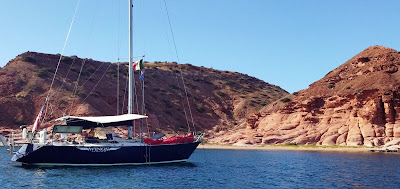 Anchored in Los Gatos
 Agua Verde
 Balandra Sand Dune
 And can we dance!
 Anchored in La Paz
 Wings in Boat Yard
 Wings Crew
 Temporary Repairs
 Fred & Rene Sailibg
 Rene in Colors
 Sarah
Sarah First look at new Genoa
 Fred takes a look
 Marilyn navigates in the Beer Can Races
 Dinner Party about to begin


.jpg)

