

March 1, 2023-Tenacatita Trip
wingssail images fredrick roswold
 Judy takes us out
I’m on watch and I’m just sitting on deck, watching. I guess that’s what you do when you are on watch; you watch
It’s midnight and we are running down wind in a strong breeze. We have a reefed mainsail and a small jib polled out on starboard jibe. The windvane is steering. The boat is fast. I’m seeing 10’s on the speedo but I don’t like it. The waves are big and the boat is rolling and swerving and the ride is a bit wild. I’m just waiting for something to break but thankfully so far nothing has.
We need to jibe towards our destination, Barra de Navidad. Judy’s watch is starting and she is getting ready to come up. I tell her, “Turn on the deck light, I have to go forward and we’ll jibe”.
Using the wind vane we turn the boat to the new heading and get the mainsail across. I put the preventer on. Now we need to get the pole over and the jib to the new side as well. I’m going forward to do that. I’m clipped in and I mostly crawl to the foredeck because the motion is wild.I shout directions to Judy. She handles the lines from the cockpit. On my hands and knees I deal with the pole and barely avoid getting conked as it swings around. The motion up here is extreme and it is exhausting just to stay on board, even though it’s only for a few minutes. I compete my task and retreat aft
Now the boat is jibed, the pole is out on the new side, and we settle down, there is 62 miles to go; less than 10 hours. By daylight the wind drops, then shifts to the south. We go close hauled and start tacking. It’s only 10 miles to go now but the wind and a strong current are against us so it is painfully slow. We’re tired and a bit frustrated. It takes three hours to get to Barra.
Judy and Mike from Honu catch our lines. It’s good to see them. Hugs.
wingssail images ros bingham
 Flamingo Regatta
The next week goes pretty good. We hang out with our friends and enjoy the Barra de Navidad experience. There are parties and drinks on the Malecon, which prove exceptionally strong and I barely avoid getting tipsy. But we have fun. I am busy planning the races next week for Tenacatita and meanwhile I’ve got to prepare for the single race in Barra, the Flamingo Regatta. I need to line up some crew. I get a bright young guy named Imas to grind and I get a guy named Cliff to do the main. Both are new to racing. Greg and Gloria also join. Greg is my jib trimmer. Gloria is doing halyards.
The Flamingo Regatta doesn’t go exceptionally well for us, 9th place out of 22. We start last, as our start time requires, and pass 15 boats, but the wrong sails for the light air and some weak crew assignments prevent us from doing better. To win we need to pass 22 boats but we don’t. We normally expect to do well and a lot of spectators thought that we would too and they bet heavily on us. We’re sorry we didn’t perform for them but their bets make money for the charity. It’s OK, we have the second highest number of bettors so we made good money for the regatta even if none of the gamblers made out on us.
Next we sail to Tenacatita. It’s supposed to be a rally but the other boats were worried about strong winds and left earlier. We sail alone. Nice sail though; there were no strong winds to worry about. Tenacatita is fantastic. Great anchorage, great weather, and many of our friends are here. The Tenacatita Race Week looks like it will come off as planned except only two races ins
tead of three.
Three days of racing seems to be too much for many of the competitors so we are cancelling the third Race.
John Knape image
 Close Racing
But what good racing it is. I’ve wanted to race in this bay for decades; it is beautiful, the wind is nice, and the sailing is outstanding and here we are on the starting line with six boats. A great start gets us off the line at speed and we are first to the top mark (which is the sailboat Karvi). The spinnaker work is good and we romp around to the finish. First Place!
>Day two the breeze is up; 19 knots. We set the small jib and again have a good start. Nobody can touch us upwind in this breeze either.
On this beat we get the rare sight of a very near whale encounter. I am steering but due to the people sitting on the high side I can’t see the water off to our side. They start telling me of a whale nearby. Suddenly a large humpback whale breaches within 50 feet of our boat, next to us. After landing it swims directly towards us and then dives under our keel. Within a few feet of us its tail slides out of sight. I half expect to feel our keel hit the whale but it does not.
We put our focus back on sailing and get to the top mark first. We set the big symmetrical kite and head off almost directly downwind. The other boats are sailing higher but we are sailing deep with the pole back and the sail is pulling well. Every minute we are gaining.
Then comes the jibe. We need to jibe to get to the next mark. In the breeze it needs to be well done but the crew is new and we’re short one person. Then I spot a snag at the end of the pole which would be a big complication.
I chicken out and say, “We’ll set the jib, take down the kite, we won’t try to jibe it.
That is successful but we’re much slower without the spinnaker. Now the boats behind who still have spinnakers are catching up. What can we do? Those boats gain inexorably and the group of closes up. Brainwaves, the nearest one, gets by.
We still have the last upwind leg and as we turn the corner toward the finish we again do well and start to regain what we lost but at the finish Brainwaves is still leading and they cross us. We finish second but are in third place on corrected time.
Third place is OK. Two other boats got places ahead of us and they are really happy. We’re happy too, because they are happy. Everyone is a winner, Tenacatita Race Week is a success.
wingssail images fredrick roswold
 Upwind in a Blow
Two days later we are heading home to La Cruz. The weather doesn’t look good. We see projections of brisk northerlies and worse the following several days. Not wanting to be pinned down we head out.
The forecast is wrong. The wind is very strong: 25-29 knots against us. That is true wind. Over the deck we are seeing 34 knots of wind. We only brought the racing mainsail and with one reef it is too much. We are overpowered. The boat is sailing fast and pounds into the waves. In trying to slow it down the sails flog. This is unpleasant. We are passing Chemala at 4:30 PM. We could go in and get out of this rough weather but the next day is forecast to be worse. We decide to carry on. The sailing continues to be very difficult however.
By 10:00 PM we decide to take down the mainsail. This is also difficult and dangerous. Our mainsail is not attached to the mast; only a bolt rope holds it on. When it comes down it comes free of the mast. In this breeze the danger is of losing it overboard, a very big hazard.
I go forward and pull down the main with two hands and try to hold it onboard with my foot. Judy handles the lines aft and controls the helm (and injures her arm when the waves briefly take control and yanks the helm over). But we do it. The main is down and lashed to the boom. We now sail with just the small jib with still over 50 miles to go, all upwind. We are surprised how well the boat sails with just the small jib. It is a lesson we are just now learning after 38 years. Wow!
With this configuration the sailing is much easier and, while the wind does not ease, we carry on with little trouble.
By noon the next day we round Cabo Corrientes and head for La Cruz but the wind is dying and we sail slowly.
We arrive safely in La Cruz at 9:00 PM.
The Tenacatita trip is over, successfully finished.
Click here for many more images.
Fred & Judy, SV Wings, Mexico
Labels: Barra de Navidad, Cabo Corrientes, Mexico, sailing, storm, Tenacatita, Wings Sailing
posted by wingssail at 12:46 PM
2 comments


Thursday, July 16, 2020
July 16, 2020-Storm Brings Rain, and Mercury Gets Check up
When we hear the storm coming we make sure the boat is secure, the awning lashed well enough, and the pipes to fill the water tanks are ready.
wingssail images-fredrick roswold
 Lightning
Lightning cracks and thunder roars, then the rain comes and our big awning collects the clear cool rain water.
Meanwhile, down in the cabin we do our boat work projects.
Today Fred is giving the Mercury a check up. Some items on this wonderful motor, after 20 years, can use a little attention: The pivot needs grease, the kill switch doesn't kill anymore, and the "in-gear lock out" for the starter needs adjustment. So while the weather outside roars Fred is happily fiddling.
wingssail images-judy jensen
 Mercury gets Check up
This is our summer: thunder storms and boat projects.
Click here for a couple more photos
Fred & Judy, SV Wings, La Cruz Huanacaxtle
posted by wingssail at 7:14 PM
1 comments
Friday, April 17, 2009
April 5, 2009-Every Day A Squall Blows Through
“OK”, her voice comes up from below deck and I know she is moving about. Soon she appears at the hatch and she scans the sky. One look is enough; she is on deck and we start the engine and are raising the anchor when the first puffs of wind come. They are cool and fresh but we are working quickly to get underway before the stronger wind hits and we don’t have time to enjoy the wind’s coolness.
wingssail image-fredrick roswold
 Judy
JudyJudy had disappeared below deck to take a nap after lunch while Jim and I sat topside and talked about airplanes.
The day was still and oppressively hot. We were anchored off a small island in the place where the wind left us when it died. The sunlight hurt my eyes and I tried to shade them with my hand but the heat reflecting off the water against my face feels unbearably hot. The resonating sound of the Cicadas on the nearby island sounded like time stopping. We found shade on deck and waited.
The season of squalls, otherwise known as the Southwest Monsoon, is fully upon us in Phuket. The days in April are boringly hot and still but we generally get a squall in the afternoon. You see them coming: a tall a dark cloud to the east or north and below it a grey mass which obscures the horizon. Then the wind starts; at first as a gentle brush on your cheek but soon it builds and continues to build until it is a force which buffets you. Rain too, a few big splattering drops fall, then sheets of it follow, drenching.
Ashore you deal with it differently then you do at sea. Ashore you pull the door shut or you hurry along to reach shelter from the wind and rain and you wait it out. It’s just an inconvenience from Mother Nature; a fact of life, nothing more.
But at sea the squall takes on a different reality. At sea when the squall comes you are alert, you watch and you are wary. The squall brings danger, maybe disaster; at least excitement.
We just went out for a short sail today; just an afternoon on the water and maybe a chance to get the sails up and hopefully see a bit of wind. It has been a month or more and we need the sailing fix. I told Judy I’d be happy with a just a few minutes hard on the wind with the sails sheeted in Wings and heeled well over. In the back of my mind was the thought that we might get the daily squall while we were out and I didn’t think that would be bad; at least it would be some breeze but there wasn’t much wind when we left Yacht Haven; just a whisper. Then even that died and we anchored.
Now I watch the clouds to the east: a tall dark thunderhead. It could be trouble brewing, a squall. At first it seems that it is moving south and will miss us but then I realize it is coming our way.
Heading directly into it we motor slowly and work the mainsail up. In the steadily increasing breeze it flaps and shakes the rig and we have some trouble with the running backstays but we get the sail up and we bear off until it fills. The boat heals over and we start to make way. I kill the engine and now we silently face the wind and Wings is moving slowly. Without much way on the rudder is unresponsive and I have to take care to avoid getting into irons. I ease the main a little to gain some speed. The helm begins to work a bit better. The boat heels even with just the mainsail. The wind is 27 knots and the sky is dark ahead. Now we are settled down and sailing and the boat feels solid under us and in control. Wings is big and powerful and when we are underway this squall is nothing to her. On board we face the wind try to see what is coming next. Rain starts to fall. I cannot go get a raincoat, so I just decide to accept the wetness. It is OK.
We see that the jib on the foredeck either needs to be secured or hoisted. We don’t know if the wind is going to continue to rise or drop off, so we delay setting the jib. Judy goes forward to tie it down.
In a few minutes it looks like the wind has stopped building so we set the jib and we sail towards the squall, but it is dying and we don’t really get up to speed before it passes as quickly as it came and we are left rolling on a still sea. We wait for a while to see if more wind will follow but it doesn’t so we drop the sails and motor home.
The daily squall has passed but tomorrow there will be another.
Click here for more photos.
Fred & Judy, SV Wings, Phuket.
posted by wingssail at 10:50 PM
0 comments
Wednesday, September 10, 2008
Just Posted: A Stormy Sail in 2002
 Sailing to Yamba
We've just posted a story from 2002 when we left Sydney on a nice morning and got a shocker when we made it out past the Heads: It was blowing like stink.
It was a rough morning but we did knock off the miles on that trip: In twenty four hours we’d covered 175 miles even against the southward flowing East Coast Current. Did we like it? During the day it was simply a fast ride we’d rather not be taking. At night it was dark, loud, and scary but we carried on, and didn’t turn in until Yamba. And no, we didn’t like it.
But we got through it.
Click here for the orginal version
Click here to read the story as we rewrote it later.
Click here for the photos from this day
Fred & Judy, Bangkok
posted by wingssail at 9:17 AM
1 comments
Saturday, March 22, 2008
Sailing Into Hell, a Story from 2004
 Black Squall
As darkness came upon us we found ourselves sailing into the hell of a huge black squall. We knew it would be night when this monster hit us and in the darkness we would be blind, unable to see or prepare, or even just know when to say a prayer.
The anticipation was worse than the squall, but the squall was bad enough; hours of howling wind and rain and Wings driving through the night under reduced sail. We two lonely sailors waited for the worst to happen, not even knowing what the worst was, but thankfully it never did.
It was just another night at sea.
Fred & Judy, SV Wings, Bismark Sea, Jan. 19, 2004
We've just posted a story from that passage. Click here to read about our passage from Papua New Guinea to Palau.
Or just click here to see the photos.
Fred & Judy, SV Wings, Phuket Thailand
posted by wingssail at 2:58 AM
0 comments
Saturday, October 27, 2007
November 27, 1998, The Night Julie Black Died
 50 Kts
We had survived a bad storm earlier and safely made port in Opua, New Zealand in November 1998.
After a few days of cleaning up and drying out the boat we went out into the Bay of Islands and anchored in Opunga Cove. Then another storm developed and on this day, November 27,1998, we heard that the storm was coming and the wind was expected to be strong overnight. It was; by nightfall we had 50 knots.
Some time after midnight the radio crackled to life with traffic between the NZ Air Sea Rescue and a ship out in the storm: The ship had just sighted the sailboat Salacia, reported in distress with two people aboard, Mike Fritz and Julie-Ann Black, both friends of ours, and they were going to try to rescue them.
Before the night was over Mike was safely aboard the ship but Salacia was sunk and Julie was lost. I sat up at Wings' nav station straining to hear each radio transmission. Listening as that rescue attempt unfolded was one of the most gripping and heart rendering hours of my sea-going life.
Read the full account here.
Fred Roswold, SV Wings, Singapore
Labels: storm
posted by wingssail at 9:06 PM
0 comments
Sunday, September 02, 2007
August 19, 2007-Windy Day at Western Circuit
 Windy and white-out conditions
Three weeks after Day 2 of the Western Circuit I still have vivid images from that race.
The strongest is of power; the power of big sails and big wind. A squall blew through and for nearly an hour the boat was sailing in the 8’s and 9’s as the wind reached the low 30’s. We were powered up.
Wings was driving through the seas, a river sweeping by the hull, white foam rolling along side. The power gripped the rig and the hull and strained the sheets and I could feel the power in my hands on the helm. It was a good feeling to have excess power at my disposal, and the strong, solid feel of the boat was reassuring and gave me confidence. I love how the boat’s reactions to my input quicken at that speed and I love it when I can harness, control, manage, and use that power. I could feel the pressure on the rudder of the flow of the water and the turbulence and the way the boat would respond and swerve to my pull on the tiller; all of this I felt with my body and my hands and in the hairs on the back of my neck and it left an indelible and intoxicating image. After sailing like that you just want more. I love that kind of sailing
wingssail image-fredrick roswold
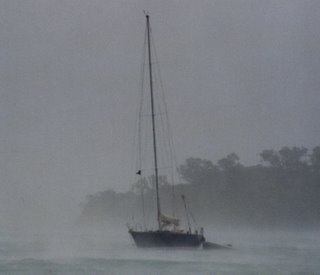
 White Squall
Then there was the visibility. We never noticed that the visibility was blanking out; we were inwardly focused, our world was 43 feet long and a few yards more, just the water directly in front of us and we were set on controlling our wild ride not looking around, but the visibility got bad. In fact there wasn’t any; the conditions were “white out”. Some boats lost their way. It came to us that we were charging along blind, we didn’t know where we were, we couldn’t even see Marambong Island to give us our bearings; it must be time to turn, but where is the mark. Check the computer.
Judy went below and after a few seconds I called to her, “Where is it?”
Her voice came up from the nav station, “Bearing Three Four Zero, ¼ mile”
I looked to the left, a flash of yellow steel wallowing in the waves, washed by the seas; we were nearly past it. “Ok, I got it”.
To the crew: “Standby to jibe.”
The jibe was a bang and a shock as the main, even on the short leash where Omar had ground it in to before I turned, slammed over and hit the stops. And the running backstay was still on, not cleated, but with too many wraps on the winch and it didn’t run out; the mainsail was plastered against it. I yelled and the tail was thrown off the winch and the main flew out. No damage done. The rest of the boat was cleaned up from the jibe and we settled down on the new heading for the run home.
Now ahead in the gloom we could just see Foxy Lady and Panic with their kites up and we could see Lunchcutter who had set their asym and flown past us in a cloud of spray. They were all were having trouble with the spinnakers. Foxy hadn’t jibed and they were headed towards the beach at 10 knots, running out of water. We saw a round up then a round down and then the spinnaker blew through the fore triangle and they were knocked down, beam to the seas. For a few minutes we could see them bareheaded, going the wrong way, just regaining control. I don’t know if something like that happened to Panic, didn’t see it, but suddenly they were bareheaded too, and while we watched Lunchcutter just ahead their kite just disappeared. We hadn’t set our spinnaker and at that point we were glad. We put the jib out on the pole and had an easier time of it than the boats ahead.
The other good memory was the earlier race against the squall on our approach to the turning mark. We were coming in with the ounce-and-a-half up on a tight reach in 15 knots of wind, already walking a fine line, on the edge, but the boat was taking it, the rudder held, the sail was quiet, we’re OK. A mile away from the mark Judy noticed the dark clouds coming in on the left; coming in fast. She voiced concern; a blow was on the way, and we had the biggest sail up, wind abeam, close to overpowered already, not a configuration in which to get caught by a blow; big problems if that happened. I looked at the sky and the dark water and I looked ahead to the mark. Should we drop the kite? There were boats near us, pushing, surfing, maybe gaining. Lunchcutter was just behind and to leeward and coming fast. If we dropped we’d lose to them but if we had the kite up when that wind hit we’d have trouble. I looked at the mark again. Tightness in my chest, nervous, but it was judgment time; time to make the call.
“Let’s hold, I think we can beat it.”
The wind started to build ahead of the squall but it went aft a little and we kept our control. More wind. The mark was 1/4 mile away now, just a minute or two more; the jib was in the feeder, ready to go up, but I held my nerve and we continued on. Nobody on the boat said a word. Everybody’s eyes were glued on the green mark ahead. We were holding our breaths.
We carried the kite right to the mark, dropped as we turned and tacked immediately in one tight maneuver just as the wind came on hard. No room for Lunchcutter inside of us, not even two feet between us and the mark. We forced Lunchcutter to round outside.
 Beating The Squall
The wind hit like a hammer. In the blast we reached off toward the Singapore side under number one and full main, flying, Lunchcutter on our hip to windward. I chanced a look back and saw the next boat behind dismasted and dead in the water; a pile of sails and spars and rigging on the deck, the crew looking dazed. Their regatta was over. To leeward boats still on the way to the mark with spinnakers up were having problems: round ups, flagging kites, flagging mains; we could see more dark round bottoms of boats showing then shiny topsides. We were in good shape though, holding a safe angle in the building breeze with only plain sails on a fast jib reach trimming aggressively and holding off Lunchcutter who rode our wake and stayed right there all the way to the next mark.
There the race course turned downwind enough for the kite again, but by then the breeze was over 28 and it was still building. For us the kite was out of the question. Lunchcutter popped their asymmetrical however and they were gone. Nothing we could do.
Later the wind dropped and we could have set but there was a hard rain, the finish was a mile or two off, we were just about home and we were still going 7.5 knots. I delayed, couldn’t make the decision, and even though Marco asked if were still racing I didn’t make the call for the kite. I waited. The rain came harder, in big drops. I had visions of a huge soaked sail down below after the race, and I looked at my sodden crew and I said, “Throw it below”. We sailed in with the jib; it was a costly decision, we were only a few minutes out of second place.
A more costly decision though was on the beat out to Johore early in the race. We were crossing tacks with Foxy and Panic, and after Marambong they went in to the beach and we stayed out for one hitch too many. I didn’t think it was right; Judy didn’t think it was right, but Omar did. It was his job to make the call and he said stay out, so we went with it. But I looked up to weather, to the beach where Foxy and Panic had a lift and more pressure and I would have done anything to be there. We weren’t. On the next tack Panic had us by 5 minutes. Omar was crestfallen. It’s Ok, Omar, we all do it.
We ended up in third, losing to Panic and Lunchcutter, but beating Foxy Lady by 10 seconds on corrected time. At the post race party Peter Forbes told me that we looked under control all day. I guess we were in control, on the outside. Inside, well inside, it was a memorable day.
And it is for days like that I sail.
Fred & Judy, SV Wings, Singapore
Click here for more images from the Western Circuit Regatta
Click here to go to the event website
posted by wingssail at 3:47 AM
0 comments
Friday, November 11, 2005
Nightmare Off New Zealand-Storm of November, 1998

We've just reposted the story of the deadly storm which hit the cruising fleet sailing from Fiji to New Zealand in November, 1998, and the tragedy which followed. Read here for the full story.
Fred & Judy, SV Wings, Hong Kong
Labels: New Zealand, sailing, storm
posted by wingssail at 7:00 PM
2 comments
Thursday, October 30, 2003
October 31, 2003-White Squall

We were sailing north in the Vela Gulf on our way to Vanga Point under the shadow of Kolumbangara, the extinct volcano known to be the home of gods whose name means "Rain King". We were happy to have wind and were wishing for more to pull our fishing lines faster but Wings was already powered up under full sail. I lazed away on deck with the wind vane steering waiting for a fish strike and Judy was down below reading. To our right the peak of Kolumbangara where the gods reside was shrouded in dark clouds and rain fell steadily on its sides but out in the Gulf it was a nice day, and we were carefree, glad to be sailing for once instead of motoring around the Solomons.
The gods on Kolumbangara watched with displeasure at our disregard for their power as we sailed by without even a glance their way. They sent out a few threatening rain squalls to dance around the shores of the extinct volcano but on Wings we took no notice, and simply sailed on. The gods then sent out one dense cloud of rain that obscured the mountain itself from our view, but we only watched its approach with slight interest, wondering if we'd get rained on.
Then the gods got angry. They sent a white squall.
The squall approached Wings with stealth, behind the rain. The wind, when it came, increased but slowly. I noticed the strengthening wind and, as Wings picked up speed under the press of canvass, I adjusted the wind vane and cranked in the sails. The wind went forward, backing, as it built. I was happy; this was sailing!
Then the wind and rain hit with a vengeance.
From 18 knots it became 22, then 26, then 30, and higher. The rain pelted down and Wings surged ahead, fishing lines singing and with a quarter wave that roared. I could see nothing around us but whiteness. The boat became overpowered with the big main set deep and full and still eased a bit out, and the boat began to round up as the wind vane struggled to maintain control. I reached for the helm and disengaged the control lines to the vane, and as Wings heeled sharply I pulled the tiller up to my chin. I looked aloft and the big main was luffing along its full length, undulating like a living thing, then waving, like a flag. Another gust hit and we rounded up more and the gentle waving turned into to a violent shaking. The mast and standing rigging and all the sheets tried to rip free of the boat and go with the wind. I wanted to run off and settle the main but I needed some more hands to ease the sheets while I steered. Judy was on deck by now and saw my difficulty and she jumped to the mainsheet winch and let out enough for me to turn the boat down. The shaking stopped as the sails filled again.
Now we ran off at 8 knots. The sea swept past in a rush and the rain hit our bare skin like lead pellets. Somewhere ahead in the mist were the reefs of Vella Lavella Island. The wind settled at 33 knots, still plenty strong and Judy took over the helm as I flattened the main and dropped the jib. We knew we should reef but downwind that would be difficult and we didn't want to take the time, not with Vella yet ahead. With the main still fully hoisted but now flat as a board, and the jib secured on deck, we turned upwind and sailed back in the direction of Vanga, now slowly and in full control. The gods on Kolumbangara saw that we were paying attention for once and they were pleased.
The squall passed.
Fred & Judy, SV WINGS, The Solomon Islands
Lat 08 deg 05 min S, Lon 156 deg 50.2 E
Labels: Gizo, sailing, Solomon Islands, storm
posted by wingssail at 7:48 PM
0 comments
Saturday, May 13, 2000
May 14, 2000-Passage to Tonga
We've been at sea now for 7 days now, going to Tonga. It’s been 6.5 days hard on the wind and most of the boats out here are complaining about it on the radio. There are at least 10 of us doing various crossings from New Zealand to the Islands, some to Tonga, some to Fiji, some to other places such as Vanuatu or New Caledonia. There were some boats going to Australia but as far as I know they all turned back to wait for better weather. Weather was a factor for our departure too. We were supposed to leave a week earlier with a group of 38 boats going to Tonga. We decided to wait for less risky weather. As it turned out their weather was much the same as what we got by waiting: moderate to strong winds against us and choppy seas. And they all made it, but a couple of them took an easier heading and diverted to Fiji. For us it's been rough and we're wet wet wet from a week of being slammed by the ocean. The tops of ocean waves which get chopped off by WINGS' bow come flying back at 40 knots and crash onto our deck and dodger, then run all over everything and finally back to the sea. The cockpit was filled like a swimming pool from the biggest waves about three times an hour for four days. We made a special effort last year to eliminate all the leaks and were successful on some but still the water gets in, mainly around the anchor chain (into the forepeak) around the mast (into the cabin) and around the back of the cockpit, (into our aft cabin bed) plus some from the main hatch and various other leaks. So dampness has permeated everything. We keep putting on dry clothes and getting them wet. The wet pile is pretty big. Every item of paper or cloth on the boat has a damp feel. Mildew is growing virtually everywhere. This boat is like a giant petrie dish. It’s surprising that things like the computer, stereo, CD players and cameras keep working, and probably at some point in the near future they won't. That will be disappointing.
WINGS likes to go to weather, does it well, but in waves like these it gets pretty wet after a few days. We need to do even more work on sealing things.
And we've had other problems besides the weather. We have had some breakdowns, one very serious. After several days of pressing quite hard for speed, in disregard for the conditions perhaps, and making some marvelous time at it. At midnight one night we broke a shroud, one of the wires which hold up the mast. It happened just as we were preparing to heave to so we could take down the main to replace a batten and that might have been what saved the rig since we got the load off of it right as it failed. Anyhow, there was this big metallic "bang" and then there was a starboard intermediate shroud hanging useless. We got the sails down and the mast stayed up, otherwise apparently undamaged. Lucky us. Twelve hours later and two trips up the rig we had lashed the loose pieces and secured the mast with a kevlar line, and we felt we could sail on starboard tack if we took it very easy. We needed to be able to sail because at 600 miles from any of the Islands, and with less than 400 miles worth of fuel left for motoring, we couldn't motor. Going back to New Zealand, the closest destination at 440 miles and where the weather was forecast to be even worse, wasn't an option we wanted to take so we needed to carry on. We considered diverting to Fiji, but it is farther than Tonga. After another day and a half and three more trips up the mast we had rigged a new (temporary) shroud and we felt that we could sail on both tacks, but only conservatively, and since then we've been making slow but steady progress and all is fine.
Repairs
The trips up the mast in the rough were difficult to say the least. It took two hands and two legs and all of one's strength, and then some, to hang on, and believe me, loosing your grip and flying around loose on the end of a 30 foot long wire hanging from the top of a 60 foot high mast which is waving wildly would be pretty serious. I made hanging on a priority. Working while up there was not easy either, but the job got done and with the boat whole again our spirits were raised tremendously. I can't tell you how bad we felt when WINGS, this wonderfully powerful and strong vessel that we love so much, was sitting wallowing in the seas unable to set sail. With it fixed, we still have a big and expensive permanent repair job ahead of us, but we feel a lot better anyhow.
There were other problems too. The bow light was carried away by the force of the water hitting it when we drove through the big seas. The battery power was getting dangerously low and we couldn't figure out where the drain was. The alternator didn't seem to be putting out much power to recharge the batteries and the Solar panels weren't producing power. The inverter would only display error messages and then shut down when ever we tried to turn it on so we had no AC to recharge the computer or grind coffee beans, as if those two things mattered at that point. We had a broken batten and a missing batten in the main and the storm jib needed a change to the luff tape and the autopilot was dis-engaging. There were a few other items too like a couple of interior lights out and some leaks we needed to plug, and some stuff I can't remember. Oh, the wind direction on the instruments went out again, a problem which has plagued us off and on for years and we've been unable to fix. This might sound like a lot, particularly since we've just spent over a year in New Zealand putting WINGS into its best shape ever, but that is what happens on a rough and wet passage. What you have to do is deal with the failures and work on them as best you can. We've fixed the autopilot and the battery problem and the charging system turned out to be fine. The solar panels are back on line, the spare inverter is online and working, the main and the storm jib are fixed, and we are using a white light for a running light. We'll keep after the list. Now if we could get some clothes cleaned and dried we'd be in excellent shape.
Safely Coiled
That's the passage so far. We've got three more days to Tonga at least, maybe more depending on the wind direction and strength but we expect to be there by the 18th or before, as we projected.
Tuesday May 16
Well, on the first part of this trip we got bashed, pounded, broken and wet. Now you can add sunburned to the list. When we reached 26 Degrees South the bad weather eased off a bit and the sun came out. The wind? Well...it just about stopped. Now we are in sunny conditions (except for on occasional cloud burst) with very little wind, and what of it there is is coming right from where we want to go. Sailing is slow and we making only a little progress toward Tonga. We motored for a couple of days, but now we have to just wait it out. We can't afford to use any more fuel because we will need it to motor around the reefs and islands getting to port. Actually, sailing slowly on a nice day is pretty pleasant, even if we aren't getting any where fast. We are both enjoying today's sail and relaxing, puttering around the boat and taking it easy. It got warm and we put on shorts and bathing suits and hung out some laundry, getting an instant tropical sunburn while doing it.
Predicting the weather for a crossing to or from New Zealand is tough. You can only get an accurate forecast for two or three days ahead, and sometimes that isn't even accurate. When we left the forecast was for two days of favorable winds, a day or two of head winds, then smooth sailing again. Instead we got six hours of good wind then four days of strong head winds. The boats that left the week before us had a much scarier forecast, with very definite strong headwinds and a possibility of a cyclone. Instead they got a passage just about like ours, from what we heard. But it looks like if we had waited even another week, and were leaving right now, the conditions would be excellent. That would have meant waiting 17 days for "the perfect weather window", which is hard to do and even harder when you are never sure that the conditions will stay that way once you leave. One thing, it is not good to be on a schedule. We wanted to go to Tonga with the group of boats, and have two months in Tonga, then go to Fiji on July 1st. So maybe we felt some pressure to leave when we shouldn't have. On the other hand, we could have wound up waiting in New Zealand all winter for the perfect window, and never got it, meanwhile missing several perfectly good passages. The Kiwi sailors tell us that "You just go. You should expect to get plastered once on each crossing and you just deal with it." Hard to say what is right.
We had a long talk last night about why we do this. There is no good answer. Its part of sailing, can't be avoided. Then why be sailors? Don't have a good answer for that either. We've had some really fun and easy passages, but these last two have been very little fun. But there are rewards, such as discovering and living in new places all the time. And you are less likely to take a place like Tonga for granted when you have to work so hard to get there. Then there is the point, (nonsense really), about "the challenge of the sea". I know it is true that we feel some inner satisfaction knowing that we faced a tough situation, when perhaps our lives and home were at risk, and that we measured up, as a team. But actually, who needs it? I think we'd both really rather not have to face these risks at all. However, being at sea, its part of the deal. Most of all, this is simply the life we have chosen. We get our real happiness from the small things, the things you can find anywhere, such as enjoying a nice dinner and a fine wine with the partner you love, or the luxury of falling asleep on the couch watching TV or reading a nice book, and from time spent with friends and loved ones. And for us, there are many of these important small things which we enjoy which are from the sailing part: a quiet anchorage, a daily chat with a friend on the dock, the feel of the boat when the water is flat and every thing is set just right, seeing the Southern Cross overhead on a clear night at sea.
But don't really ask us to explain why we do it.
Wednesday May 17
Ready for the next development? Days of calm weather. This morning when it was light we could see Ata Island to our north as we sailed slowly towards Tonga. We knew it was going to be there but still it was a surprise to see the rugged peak of rock ten miles off so clearly in the dawn. Now it is 5:00 PM and we can still see Ata Island. It reminds us of some Swiftsure races and other races in the old days when we got becalmed and had to stare at the same piece of land for what seemed like days. It’s been slow going with 4-7 knots of wind right out of our destination and the seas are big enough that we really can't point very high, so we tack through 110 degrees and make about 2.5 knots towards Tonga, still 65 miles too go. Our weather expert, Des, from Russell Radio, is calling for a ten knot Easterly. We'd take that.
On another front, after close inspection we found another piece of cracked rigging, a starboard lower shroud, which we reinforced. Turnbuckle But this makes it really clear that we are faced with a major re-rig. Expensive and tough to do in Tonga maybe. But we don't feel too bad about it. At least we are getting the chance to do it on our terms, not with pieces of broken mast all about the deck. People have told us that you should replace the standing rigging after 10-15 years, this has been up since '83, so I guess we are overdue. We've delayed because of the expense and because previous inspections have never revealed any signs of deterioration. But now, I guess we will bite the bullet.
The wind just came up a little, ten knots from the East, can you imagine that? Gotta go.
Fred & Judy, SV WINGS, On Passage
posted by wingssail at 8:50 PM
0 comments
Saturday, November 14, 1998
November 15, 1998-Nightmare Off New Zealand
 Woody Goose
New Zealand bound cruising boats, including our WINGS,were hit hard in November as a series of low pressure systems interacted with reinforced trade winds to kick up strong easterly winds and big seas. In the tough conditions which resulted at least five boats were lost and there were four tragic deaths, some of whom were friends we’d cruised with across much of the Pacific.
A fleet of about 30 yachts left Fiji, Tonga and New Caledonia ports in early November with forecasts of excellent weather. The first warning was on November 11 when a Met-Service weather fax from Wellington showed a sharp dip in the isobars to the north. The real problem was the combination of this new low and the nearly stationary high to the southeast. People started to get concerned. Most of fleet from Tonga decided to hang out at Minerva Reef until the system blew over, but those of us coming from Fiji and New Cal were committed. By noon Friday we had over 30 knots of SE wind and the seas were getting bigger. The HF radio nets were full of conversations about the rough rides and about how difficult it was to make the needed easting. On WINGS, although we had made a good run in the last 24 hours, 160 miles close hauled on port tack, and we holding our line to the Bay of Islands, we were having rough going. Under a double reef main and number 4 jib we were making seven knots, right down the rumb line, but we were taking a pounding, the waves were constantly coming over the top of the boat, and the windvane was working real hard to keep us on course. We had to slow down. Eventually we wound up motorsailing under a third reef as the wind peaked at 45 between gusts which we didn’t even measure and the waves turned into small mountains.
After a rough eight day passage we arrived at 3:30 AM on November 16, in Opua New Zealand. Cold, tired, but safe, along with five or six other yachts. By the next day we started hearing about the problems the rest of the fleet was experiencing.

Woody Goose, a beautiful wooden 53ft Ketch from Britain, with husband and wife Roger and Anita aboard, was overdue. Without a HF radio, and because of several other problems they had been dealing with such as a repeatedly failing steering system and other damage suffered in a grounding in Fiji, they had been buddy boating with another yacht. During the early days of the storm the two boats lost touch with each other and Woody Goose did not come up on the VHF radio. Their friends went back for four hours looking but never again saw Woody Goose. On Tuesday Morning the word swept through the cruising fleet in Opua: Woody Goose had gone on the beach north of there and Anita was lost in the surf and drowned. Days later, during trips to the wreck site on the long sandy beach in New Zealand’s Great Exhibition Bay where the cruisers went to help salvage equipment from the broken boat, the story came out. Exhausted after days of hand steering, they had decided to anchor off the coast. Even knowing that the lee shore was dangerous, they desperately needed a rest. In the early morning hours the boat dragged, the engine wouldn’t start, and when they tried to sail off the steering failed. In the surf Anita was swept overboard, her harness was left hanging empty in the cockpit. Roger set off flares and tried to search for her, but to no avail. When help, in the form of the local constable arrived, he and Roger found Anita’s body on the beach a few hundred yards from Woody Goose’s battered hull. Even though nearly everything removable, including the engine and the masts were saved, the boat itself was a total loss, it’s ribs broken and it’s bottom ripped out.
At the same time two boats to the north west of New Zealand were also in trouble. Energetic II had been dismasted and was drifting west, away from New Zealand. Energetic II crew of three (plus one dog) were able to clean up their boat and start powering west towards Lord Howe Island. No way could they motor against the wind and seas to New Zealand. Then the news reports came in on Janamarie, another 50 plus foot New Zealand vessel on the way home with four persons aboard. They were rolled in huge seas and two persons were lost. The rig was down and the pilot house windows were all blown out. One crew member was on deck with the owner preparing to go below when the incident happened and he was washed over, never to be seen again. The owner was on deck with him but his harness held and he survived. His wife and the other crew were in the pilot house and, unbelievably, the second crew member was sucked out a broken window and also lost. The survivors were seriously injured with lacerations and broken bones, but they struggled in spite of their injuries to keep the boat afloat. Help arrived in response to their EPIRB and they were rescued. Their boat was left at sea. The rest of the fleet, including single handers Caledonia and Talisman, straggled in one by one to Opua New Zealand, all with stories to tell, but alive.
Meanwhile, well to the east, the storm had passed and the fleet at Minerva Reef headed out on their passage to New Zealand. At the start their conditions were mild and the lead boats made good time. Before any of them arrived in New Zealand however another low had formed and the coming weather was forecast to be even worse this time than the one which had hit Woody Goose, Energetic II and Janamarie. By November 27 many of the boats had made it in ahead of the storm but on that day an EBIRB signal was received from a vessel named FREYA, just east of Cape Brett off the Bay of Islands. They were dismasted, disabled, and sinking. New Zealand’s top notch air rescue services found the boat and lifted the three persons who had been on board to safety. FREYA was left at sea and not seen again. The same day a VHF distress call was received in the same vicinity from SALACIA, another boat coming from Tonga with two persons, Mike Fritz and Julie-Ann Black on board. They were also disabled and drifting towards shore, but without EPIRB to help rescuers to find them. All day and night Friday cruisers listened spellbound on VHF to the radio traffic of the searchers looking for SALACIA just west of the Bay of Islands. At the time we were all hunkered down in bays and coves with winds in the anchorages in the high 50’s and driving rain which made visibility nearly zero. The seas off the coast where SALACIA was reported to be were horrific. Early in the morning of November 28th a Kiwi Air Rescue aircraft reported that they had located SALACIA and they had vectored a merchant ship to the scene. At dawn, before a helicopter had arrived, the crew of the ship apparently attempted to rescue the two sailors from SALACIA. Later, on the ship’s VHF Mike reported that both persons were thrown life rings. He saw that Julie was in hers, (he said that she also was in a survival suit and life jacket) and then he went to the bow of SALACIA and pulled the second life ring over his own head. He was lifted aboard the ship but Julie was lost from her ring and not seen again. Mike said at first that he thought she had stayed on the boat and gone below, but no one actually saw this. When the ship returned for a second pass to get Julie, all they reported finding was wreckage from SALACIA. Even though the search was continued all day, no sign of her was found, nor was SALACIA seen afloat after that.
Wings, Anchored in New ZealandClick here to see the log book pages of this passage.
Fred & Judy, S/V WINGS, Auckland, New Zealand
Labels: crew, New Zealand, sailing, storm
posted by wingssail at 5:51 PM
0 comments
Thursday, September 25, 1997
September 27, 1997-Duckin' the 'canes
Hurricane Linda was no problem, it took one little peek into the Sea of Cortez down by Cabo San Lucas and decided to go west young man, and never touched us. However the satellite pics we received were awesome, awesome.
Linda Appears
And Moves Away
Nora Appears
Nora Sneaks into the Sea of Cortez
Hurricane Nora, on the other hand, came up the outside, snuck over the Baja mountains and raised a little ruckus here for a couple of days, but since we been hidin' out behind a mountain called "Tits of the Goat (Tetas de Cabra)" we were protected from most of the storm, and it didn't pass that close anyhow. Now it's gone and we are watching the next one. We do consider ourselves very lucky though, because we made it in here, where we just got a little wind for 36 hours, but no problema. At least a couple of boats, one nearby and one up north, were caught in open roadsteads and wrecked by dragging onto shore in bad seas. No people injured that we know of. The rest of the fleet of boats cruising the Sea of Cortez made it to various bays and harbors, mostly on the west side of the Sea where they are holed up, hoping that no storms get too close. We are here on the east side, hanging out at the Mai Tai bar. Tonight we watched the live E.R. premier and had two for one drinks.
So, WINGS is fine, so are we.
We'll write again soon
Fred & Judy, SV Wings, San Carlos
posted by wingssail at 5:58 PM
0 comments
About Me
.jpg)
- Name: wingssail
- Location: Seattle, Washington, United States
.jpg)
I am a sailor, born of a nautical tradition passed to me by my father and my Grandfather Alfred. I’ve spent most of life on my passion which is the sea and the vessels which go upon them. I have had many such vessels and now I live on and sail on the sloop WINGS. which I acquired in 1986 with my wife Judy who shared my passion. For ten years we lived on Wings in Seattle and sailed, including racing. Then we left the Pacific Northwest and voyaged across the world, across the seven seas, to faraway places, and made them our own. For thirty-eight years I have lived and loved this life. I still live on Wings, in Mexico, and sail and race often. Judy passed away in June, 2023 and I miss her but you can still join us and sail the seas as we did for all those glorious years. Fred Roswold, SV Wings, Mexico

Recent Posts
- September 30, 2026-Road Trip through Historic Mexico
- July 1, 2026-Spring Cruise and Adventures in the S...
- Feb 28, 2026-Tenacatita Cruise plus Engine Project...
- July 7, 2025- Spring Cruise to Sea of Cortez
- March 23, 2025- Banderas Bay regatta and thoughts ...
- Feb 20, 2025-Cruise to Tenacatita
- Dec 24.2024-Racing success and Merry Christmas
- December 2, 2024-Work and Play in The Final Days o...
- July 23, 2024-Spring Cruise Wrap-Ip
- May 2, 2024-Sailing Upwind on a Windy day with Sarah
Links
- Wingssail Images
- Taipan, Kris & David
- Jim Slosson-Tanzer 16 (Jim's Little Boat)
- Anasazi Racing-James Burwick, Somira Sao and their three small children
- Noonsite-The Global site for cruising sailors
- Scuttlebutt
- Sloop Tavern Yacht Club
- Corinthian Yacht Club of Seattle
- Panbo's Marine Electronics
- 48 Degrees North Magazine
- Matt Drayer's Serendipity 43 list
- Sailor's Rants
Country Index
- Africa
- Antigua
- Aruba
- Australia
- Bequia
- Bonaire
- Borneo
- Brazil
- Brunei
- Cambodia
- Canada
- China
- Colombia
- Costa Rica
- Curacao
- Dominica
- Fiji
- Grenada
- Hong Kong
- Indonesia
- Malaysia
- Martinique
- Mauritius
- Mexico
- Myanmar
- Namibia
- New Caledonia
- New Zealand
- Nicaragua
- Palau
- Panama
- Papua New Guinea
- Philippines
- Polynesia
- Reunion
- Saint Helena
- Samoa
- Singapore
- Solomon Islands
- South Africa
- St Vincent and the Grenadines
- St. Lucia
- Tanzania
- Thailand
- Tonga
- Trinidad
- USA
- Vanuatu
- Zanzibar
History
- July 1996
- August 1996
- September 1996
- October 1996
- December 1996
- January 1997
- February 1997
- March 1997
- June 1997
- July 1997
- August 1997
- September 1997
- October 1997
- November 1997
- December 1997
- January 1998
- February 1998
- March 1998
- April 1998
- May 1998
- July 1998
- August 1998
- September 1998
- November 1998
- December 1998
- January 1999
- February 1999
- April 1999
- May 1999
- November 1999
- April 2000
- May 2000
- June 2000
- July 2000
- August 2000
- September 2000
- October 2000
- November 2000
- December 2000
- October 2001
- January 2002
- June 2002
- August 2002
- September 2002
- October 2002
- November 2002
- December 2002
- July 2003
- August 2003
- September 2003
- October 2003
- November 2003
- December 2003
- January 2004
- February 2004
- March 2004
- April 2004
- May 2004
- June 2004
- September 2004
- January 2005
- April 2005
- May 2005
- June 2005
- July 2005
- August 2005
- September 2005
- October 2005
- November 2005
- December 2005
- January 2006
- February 2006
- March 2006
- April 2006
- May 2006
- June 2006
- July 2006
- August 2006
- September 2006
- October 2006
- November 2006
- December 2006
- January 2007
- February 2007
- March 2007
- April 2007
- May 2007
- June 2007
- July 2007
- August 2007
- September 2007
- October 2007
- November 2007
- December 2007
- January 2008
- February 2008
- March 2008
- April 2008
- May 2008
- June 2008
- July 2008
- August 2008
- September 2008
- October 2008
- November 2008
- December 2008
- January 2009
- February 2009
- March 2009
- April 2009
- May 2009
- June 2009
- July 2009
- August 2009
- September 2009
- October 2009
- November 2009
- December 2009
- January 2010
- February 2010
- March 2010
- April 2010
- May 2010
- June 2010
- July 2010
- August 2010
- September 2010
- October 2010
- November 2010
- December 2010
- January 2011
- February 2011
- March 2011
- April 2011
- May 2011
- June 2011
- July 2011
- August 2011
- September 2011
- October 2011
- November 2011
- December 2011
- January 2012
- February 2012
- March 2012
- April 2012
- May 2012
- June 2012
- July 2012
- August 2012
- September 2012
- October 2012
- November 2012
- December 2012
- January 2013
- February 2013
- March 2013
- April 2013
- May 2013
- June 2013
- July 2013
- August 2013
- September 2013
- October 2013
- November 2013
- December 2013
- January 2014
- February 2014
- March 2014
- April 2014
- May 2014
- June 2014
- July 2014
- August 2014
- September 2014
- October 2014
- November 2014
- December 2014
- January 2015
- February 2015
- March 2015
- April 2015
- May 2015
- June 2015
- July 2015
- August 2015
- September 2015
- October 2015
- November 2015
- December 2015
- January 2016
- March 2016
- April 2016
- May 2016
- June 2016
- July 2016
- August 2016
- September 2016
- October 2016
- November 2016
- December 2016
- January 2017
- February 2017
- March 2017
- April 2017
- May 2017
- June 2017
- July 2017
- August 2017
- September 2017
- October 2017
- December 2017
- February 2018
- March 2018
- April 2018
- May 2018
- June 2018
- July 2018
- August 2018
- September 2018
- October 2018
- November 2018
- December 2018
- January 2019
- February 2019
- March 2019
- April 2019
- May 2019
- June 2019
- July 2019
- August 2019
- October 2019
- November 2019
- December 2019
- February 2020
- March 2020
- April 2020
- May 2020
- June 2020
- July 2020
- August 2020
- September 2020
- October 2020
- December 2020
- January 2021
- February 2021
- March 2021
- April 2021
- May 2021
- June 2021
- July 2021
- August 2021
- September 2021
- October 2021
- December 2021
- January 2022
- April 2022
- May 2022
- June 2022
- August 2022
- October 2022
- January 2023
- March 2023
- April 2023
- May 2023
- June 2023
- July 2023
- August 2023
- September 2023
- October 2023
- November 2023
- December 2023
- January 2024
- February 2024
- April 2024
- May 2024
- July 2024
- December 2024
- February 2025
- March 2025
- August 2025
- March 2026
- August 2026
- October 2026
Complete Index of Wingssail Blog
- AC
- Aircraft
- America's Cup
- Animals
- ARC
- Art
- Baja
- Bang Tao
- Bangkok
- Beach
- boat work
- Brunei
- california
- Chang Mai
- crew
- Dancers
- Family
- Australia
- Borneo
- Cambodia
- China
- Fiji
- ABC'S
- ABYC
- Africa
- Agulhas Current
- Alarife
- Alert
- Altata
- Amazon
- Anasazi Girl
- Angie
- Antigua
- Antigua Sailing Week
- Aquarios
- Aruba
- Asenvari
- Asia
- Atlantic Ocean
- Bahia Conception
- Ballena Bay
- Balmar
- Bandaras Bay
- Banderas Bay
- Banderas Bay Blast
- Banderas Bay Regatta
- Barra de Navidad
- Baru
- BBR
- Bequia
- Birds
- Black Magic
- Bloemfontein
- Bloodhound
- boat design
- Boca Chica
- Boca de Tomatlan
- Bonaire
- Brazil
- Bucerias
- Budi Budi
- Bundaberg
- Café Rene
- Canada
- Cape Alguhas
- Cape Town
- Cargados Carajos Shoals
- Caribbean
- Carina
- Cars
- Cartagena
- Cartagena. Renaissance
- Casa Mexicana
- Central America
- Chaguarmas Bay
- chainplates
- Chamela
- Charlotteville
- Charts
- Chiapas
- Cholon
- Christmas
- Chrysler 300M Special
- classic yachts
- Cleofas
- Clifton
- Club Nautico
- Colombia
- Colon
- Coral Cove
- Corinto
- Cornelius Bruynzeel
- Costa Alegre
- Costa Rica
- Coyote Bay
- Curacao
- Dar Es Salaam
- Darien
- Datai
- Day of the Dead. Dia de los Muertos
- Dingy
- Dominica
- Dos Lencois
- Doug Peterson
- Downwind Umbrella Race
- Driving
- Durban
- Ebora
- Eclipse of the Moon
- EnergydietHD
- English Harbor
- Ensenada Carrizal
- Falmouth Harbor
- Fernando de Naronha
- Fish River Canyon
- Flowers
- Fort San Filipe
- Fortaleza
- Fortaleza Yacht Club
- Fred & Judy
- fred
- Fred and Judy
- friends
- Ganbare
- Garden Route
- Gecko
- Gene Mim-Mack
- Gizo
- Glasspar Superlite
- Golfito
- grand bay
- Grand Port
- graphics
- Green Island
- Grenada
- Guadalajara
- Gulf of Nicoya
- Gulfo Morrosquillo
- Harmony Hall
- High Veld
- Hluhluwe-iMfolozi
- Hog Island
- Hong Kong
- Honu
- Hout Bay
- Howard Brown
- Hua Hin
- Huatalco
- hurricane
- Ian Hulleman
- index
- Indian Ocean
- Indian River
- Indigo Pearl
- Indonesia
- Isla San Francisco
- Izapa
- Jan Brown
- Jim Burwick
- Jim Slosson
- Jimmy and Robin
- John and Elinore
- Jolly Harbor
- Jolly Olly
- judy
- Julian Mustoe
- Kavieng
- Kedah
- Khao Sak
- kite boarding
- Kite surfing
- KL
- Knysna
- Kokomo
- Kruger National Park
- Kuala Lumpor
- Kuna Indians
- La Brea
- La Cruz
- La Cruz Huanacaxtle
- La Manzanilla
- La Paz
- La Victoria
- Lanakal
- Langkawi
- Las Hadas
- Las Perlas
- Led Zepplin
- LIMA
- Los Lanitros
- Louisiades
- Loyalties
- Luderitz
- Luis Correia
- Mahebourg
- mainsail
- Malaysia
- Malecon
- Manzanillo
- Maranhao
- Marias Islands
- Marina
- Marina Aven
- Marina Riviera Nayarit
- Martin Carriere
- Martinique
- Mauritius
- Mazatlan
- Mazatlán
- Medical
- Melaque
- Mercedes Benz
- Mercury
- Mexican Navy
- Mexico
- Mexico City
- Mike and Judy
- Mike Danielson
- Military
- Minca
- Mooloolaba
- Mossel Bay
- music
- Myanmar
- Myles Marine Electronics
- Nai Yang
- Namib Desert
- Namibia
- National Beauty Contest
- nature
- New Caledonia
- New York
- New Zealand
- Nicaragua
- nikon
- Noason
- Nonsuch Bay
- Nuevo Vallarta
- NZL 32
- Oaxaca
- Opencpn
- Osler Marie
- Pacific Coast
- Pacific Ocean
- Palau
- Panama
- Panama Canal
- Panama City
- Pangas
- Papagayo Winds
- Papua New Guinea
- Patricia
- Paul Sungalle
- Philippines
- Phuket
- Pierre
- Piracy
- Pirates Cove
- Pitch Lake
- Playas de Cocos
- Poas Volcano
- Polynesia
- Port Angeles
- Port Elizabeth
- Port Louis
- Port Moselle
- Powerboats
- Proa
- Protests
- Pta Mita
- Puerto Azul
- Puerto Escondido
- Puerto Vallarta
- Puesta del Sol
- Punta Burros
- Punta Mita
- Punta San Bernardo
- Puntarenas
- racing
- Rage
- Randy and Laura
- RCYC
- Rebak
- Reunion
- Richard's Bay
- rig
- Rio Macuripana
- River Trip
- Riviere Noire
- Roaring Forties
- Rosarios
- Russians
- Sabah
- Sailbags
- sailing
- Sails
- Saint Helena
- Samoa
- San Blas
- San Blas Islands
- San Jose
- San Juan Del Sur
- San Sebastian del Norte
- Sand Dunes
- Sand Groper
- Santa Cruz Baai
- Santa Marta
- Santa Rosalia
- Sao Luis
- Sapzurro
- Sayulita
- Scotland Bay
- Sea Lions
- Sea of Cortez
- Seattle
- Serendipity 43
- sewing
- Shelter Bay Marina
- shipwreck
- Shirley Heights
- shirts
- shopping
- shrouds
- Simonstown
- Singapore
- Soccer
- Solomon Islands
- Somira Sao
- South Africa
- South America
- South Island
- spinnaker
- St Pierre
- St Vincent and the Grenadines
- St. Brandon Rocks
- St. Lucia
- Steel Pan Band
- Steel Pan Bands
- Steinbeck Canyon
- Stone Town
- Store Bay
- storm
- Stormvogel
- Sumatra
- Summer Sailstice
- Surfing
- Swiftsure
- Table Mountain
- Tacana
- tanjung ruh
- Tanna
- Tanzania
- Tapachula
- taratao
- Tehuantepec
- Tenacatita
- Tepic
- Thailand
- Thailoand
- Thanksgiving
- Tobago
- Tommy Dreyfus
- Tonga
- Topolobampo
- Trinidad
- Tuxtla Chica
- Tuxtla Gutierrez
- Tyrrel Bay
- ulu
- Union Island
- Union Juarez
- USA
- Vallarta Cup
- Van de Stadt
- Vanuatu
- Vern Ruskin
- Victory
- Virus
- Volcano
- Walvis Bay
- Wanaka
- Warbirds over Wanaka
- Warrior
- Washington
- Waves
- weather
- Western Cape
- Whales
- Willemstad
- William Fife II
- Wings
- Wings Sailing
- Wings Sailing. Isla Santa Maria
- yachts
- Yole
- Zanzibar
- Zihuatenejo
- Zululand
