January 10, 2004-Papua New Guinea-About the Country
Our visit to Papua New Guinea began in the Louisiades, the island group far to the east of mainland Papua, where we sailed to from Australia in 2003 and where we joined several other yachts cruising amongst the islands interacting with the local Papuans.
wingssail images-fredrick roswold
 Papua New Guinea Papua New Guinea
The remoteness, the ruggedness, and the history of the area drew us in. Papua New Guinea was a spectacular region with extensive cruising grounds and it had a fascinating history. Papuans had been one of the earliest cultures in the world to domesticate plants, around 7000BC, and yet they were one of the most recent people in the world to practice headhunting and cannibalism. Papua New Guinea intrigued us.
We stayed in the Louisiades for two months and it was delightful. We met many lovely people, saw awesomely beautiful scenery, and learned more of about the history. It was a largely unspoiled area.
Later we traveled through other parts of Papua New Guinea, mostly in the Bismarck Archipelago including Bougainville, New Britain and New Ireland. We avoided the mainland itself because we heard so often that it was a high crime area and we even heard of violent crimes against cruisers. But the Bismarcks, we’d heard, while still dangerous, were safer. We found that claim to be true and we also found that cruising in Bismarck Archipelago was like going back in time a few hundred years. It was beautiful but primitive. The islands were stunning, the sailing adventurous, and the cruising possibilities endless. The towns were rough but friendly and in the villages the people maintained customs and lifestyles which seemed almost from prehistory. Despite the warnings about crime, during our entire visit to Papua New Guinea, we never had any problems with crime or any other issues. Yet, in the end, despite having a really wonderful cruise, we didn’t like it. There was something dark and dangerous lurking in Papua New Guinea and it put us on edge. The danger was tangible. The problem is that the people are violent.
wingssail images-fredrick roswold
 Proa sailing,Papua New Guinea Proa sailing,Papua New Guinea
The concern about violence was more than about the high crime rate or the numerous reports of murders which filtered in from the bush, or even utter obliquity of domestic violence; it was the attitude of acceptance the people seemed to have towards violence. A village could be massacred by a neighboring village, which we heard of while we were there, and the police would investigate for two weeks, then the police would announce, “The matter is settled; several pigs have been exchanged.”
Cruisers were not safe, either. While we were there some were robbed and attacked and even killed. The worst places were the cities on the mainland island of Papua. Towns like Medang and Lae looked safe, and the streets were quiet, but then you noticed that the phones were all ripped off the walls of the post office, and most of the men carried machetes. There was a simmering anger in Papua New Guinea and you were never sure when it would be directed towards you. We were glad to leave.
 Pig Roast on Pan Numera Island, The Louisiades Pig Roast on Pan Numera Island, The Louisiades
The Louisiades were different. They are still part of Papua New Guinea but the people there seem to be happier, not so angry. Reports of theft were rare in the Louisiades and we heard nothing of violence; we really didn’t feel we had to worry about safety in the Louisiades. And we enjoyed it there.
However, getting there was no piece of cake. Our trip from Australia was quite an adventure.
Read here about our arrival in the Louisiades.
Click here to read all the stories from the Louisiades.
Click here to see all the photos From the Louisiades
You can read more about the security in Papua New Guinea on noonsite: Papua New Guinea
Fred & Judy, SV Wings, Kavieng, Papua New Guinea
Labels: Louisiades, Papua New Guinea
September 10, 2003-Misma
wingssail images-fredrick roswold
 Bwagoia Town, Misma Island, The Louisiades Bwagoia Town, Misma Island, The Louisiades
The big town in these parts is Bwagaoia Town on Misima Island. Most people just call the town Misima, dispensing with Bwagoia name altogether, but if you want to say Bwagoia, you say it "Baw Gaw Wah". Bwagoia is the customs and immigration clearance port mainly because of the substantial gold mine there, the operation of which results in a lot of traffic in and out of the country. But since it is a clearance port it is convenient for the yachts which come to Papua New Guinea to visit the Lousiades to clear in and out here. Actually, without the availability of Misima most yachts wouldn't come Papua New Guinea at all, or they would do it without checking in because there is no other port anywhere near. Going to one of the mainland ports, besides exposing yourself to a crime problem, means you'd have to beat upwind in the trade wind belt to get to the Lousiades, or if you stayed and cruised the mainland, then you'd have a beat back to Australia. Neither choice is to inviting to most cruising yachts. Anyhow, Misima makes the Lousiades possible for us.
The other side of the coin is that without the requirement to check in and out at Misima, most yachts wouldn't bother coming there either. They’d just bring what they expected to need from Australia, and when the food ran out they’d go back.
We, on the other hand, rather liked Misima despite the fact that it's pretty much a dreary place and the weather is generally bad and most of what we needed to buy wasn't available anyhow. But there are several stores there and we did find a lot of what we wanted. We restocked provisions with what we could, buying rice and flour and canned tuna, etc, the normal stuff you find in these island stores, plus beer and liquor. But the treat was fresh bread. We visited the bakery nearly every day for some small loaves which looked and tasted like out favorite "bollios" from Mexico.
Bwagoia itself is a few dozen buildings on a flat, dusty, piece of ground next to the brown water of an inlet on the east end of Misima Island. There are three beat up piers next to town usually with a few equally beat up island traders tied to them. The yachts anchor a 100 yards off, and dingy to shore. When you walk into town from the wharf you find it full of Papua New Guineans, mostly chewing Betel Nut and watching the white people. There is a produce market, where you can buy Betel, and sometimes some other produce, and there they laugh when you speak to them. There are some roads out of town and some businesses on them, but right in town there are two large Korean owned, general stores, with certain canned goods like tuna and spam, dry goods, a cooler for pop and butter and eggs, and a freezer for a small selection of frozen meats and a smattering of fresh produce. But you could also get bikes, a little hardware, clothing, batteries, film (although I never saw a camera), pots and pans, electronics, and probably a lot more that we never really looked into. For my part, I needed a new watch, having foolishly broken my last one trying to dry it out after snorkeling with it once too often. (Too bad too, because it had five alarms which I used to remind me of the five weather fax times every day). Well, anyhow, I needed a new one, which was impossible if I was looking for an exact replacement, but I did find some alarm watches for about $7. I bought two.
Plus there is the bakery, a couple of smaller general stores, three liquor stores, (but we only found two of them) a fuel depot, and a couple of second clothing stores.
Up the hill there are the government offices, a hotel (called a guest house) a hospital, the communications station with a massive satellite dish, the high school, a satellite TV company, a car repair shop. I think you get the idea. We took some walks around town, mostly on the dusty roads, or we hung out at the hotel where you could get a cold beer.
That’s Misima.
Click here to see all the photos From the Louisiades
Fred & Judy, SV Wings, Misma, The Louisiades
Labels: Louisiades, Papua New Guinea
September 10, 2003-Fast Trip to Bwagoia
wingssail images-fredrick roswold
 Sunset Bwagoia Harbor, The Louisiades Sunset Bwagoia Harbor, The Louisiades
We got the anchor up at 08:45 and set sail inside the reef for One Pass East in a nice 15 knot SE wind and calm seas. It was downwind and we sailed with just the main. We put out the fishing lines but we didn't catch anything. After an hour of sailing we jibed around a reef which was a waypoint and then we set the jib. As it would do, the wind immediately came up to 20 knots, but it was still easy sailing, and still no fish.
At 11:10 we went out through the pass, One Pass East, which is not named on any chart but it is one pass east of our favorite anchorage so we gave it that name, and by then the wind was up into the mid twenties and solid. The pass itself was easy, flat calm and good visibility, and in fact I enjoyed it thoroughly with all the colors of the water and sandbars and islands. Right outside the pass however we saw some pretty huge standing waves and we headed up into the wind a bit where they seemed less, but still we got into some really good waves. Once out of the rough stuff we bore off to Bwagaoia, 20 miles distant. The wind was still strong, and the waves still plenty big enough to soak us once in a while, but it was, again, easy sailing, and we made good time. Two hours and twenty minutes later we sailed into Bwagaoia Harbor, having averaged 8.4 knots across from the pass on a beam reach, and anchored just off the town wharf.
A good fast trip, but no luck fishing this time.
Click here to see all the photos From the Louisiades
Fred & Judy, SV Wings, Bwagoia
Labels: Louisiades, Papua New Guinea
September 9, 2003-Wind Bullet Alley
To our way of thinking Pana Wina is its own special version of hell; what are we doing back here?
Well, we are on the way to Misima, and Pana Wina is a half way point, and some friends are here, and we agreed to meet them, so we stopped. But we knew it was a mistake as soon as we rounded the corner into the bay. When the first gust hit us it caught us head to wind and set the sails flapping and it seemed like all hell broke loose, and this was the anchorage. The wind whips through this anchorage like little cyclones about once every 10-20 seconds, or if you are lucky, they give you a minute or two before blasting. I don't know how strong they are, our instruments are not reliable right now and besides, the gusts are too short for the averaging, but if it's blowing 20 outside, it must be 30 or more here in the gusts.
We sailed in with a full main and the number 4 jib; not much sail but for Pana Wina's gusts, it was too much. In the lulls we stood straight up and stopped. In the gusts we were knocked over to our beam ends, meaning down so far it was hard to hang on. Oh, I guess I thought it was exciting, but who needs it. Dropping and folding the sails was also exciting. Needless to say we worked fast. Judy is dynamite on the foredeck when she needs to be.
So we arrived here and anchored, in 40 feet of water in good sand, away from the coral patches and bommies, made the boat secure, and it’s time to go visit our friends. We're fine here, but we hate it. Hata Lawi was much better.
Fred & Judy, SV Wings, Pana Wina, Lousiades, Papua New Guinea
Labels: Louisiades, Papua New Guinea
August 11, 2003 People of the Lousiades
 Sam Works on the Carving Sam Works on the Carving
Much of the adventure of this cruise has been the local people we've met. We've met many Papuans, mostly island people. The island people of Papua New Guinea are delightful people and we love them. They claim however that they are different from the "highlanders", those people who still live in the mountains of the mainland, and only in recent times have begun to adopt what we might call civilized ways. The island people we've met are happy, friendly people, and they accept us as guests to their island homes. On the other hand, they tell us that the highlanders are a darker race, not only in the color of their skin, but in their hearts. There is much written in the local press of violence and killing in the highland villages and in the cities where the highlanders have come to look for jobs or to get into trouble. The skirmishes reported are shocking; ten people killed for example, because of an allegation of black magic, or someone whose limbs have all been hacked off, in vengeance for an insult. The police cannot stay ahead of this crime, it is just too endemic and they are too few, too weak. After one massacre the police spokesman announced that, "The matter has been settled, several pigs have been exchanged."
But we've stayed away from the cities and the mainland, and we've met few highlanders.
The worries about highland violence does not even enter our minds as we interact with the locals in the islands of Papua. Today we spend most of the day on Bagamon Island, trekking from one end of the island to the other, visiting three villages on the way.
In the far village, Bryan, a cruiser who in his previous life was a cook, was teaching bread making. He'd been in the village on several days, all arranged of course, and he'd built an oven in the village square, out of rocks and cement and a steel oil drum. In this oven the villagers could bake bread and pastries, if they knew how, and today Brian taught them. The recipes were simple. For bread, a few packets of yeast, two kilos of flour, some salt, lots of kneading, and let it rise twice. The pastries were made from half self raising flour and half normal flour, some pig fat, roll it flat, and fill it with local fillings. Everything popped into the oven and left until it was golden brown.
Brian tests oven
The women watched intently and discussed the recipes and techniques while the men tended the cocoanut husk fire under the steel drum of the oven. Bryan moved back and forth between the outdoor kitchen and the oven, keeping both going, and the rest of the village sat around and socialized, just happy to be part of the event. Judy drew a crowd as she passed out balloons to the kids.
When the first pastries were done everybody had a taste and the day was deemed a success.
We began our walk back across the island, past Oysi village where chief Gulu and some of his sons sat at their work bench under the tree making crafts for sale to the yachties, past the beach where our dingy waited anchored offshore and tied to a tree, and on to far side of the island to another village where Sam's house was. We needed to visit Sam because we'd contracted with him to carve a name board for Wings that we wanted to use on our main hatch and Sam had not completed it. We needed to tell Sam that we were leaving in the morning and he needed to get going on the job before we departed.
While we were at Sam's the rain came and we clustered under the eves of his house, and most of his village came around too and we met all of them. I sat inside the doorway of his house on his raised floor and showed Sam exactly what we expected from his carving commission, and Judy chatted with his wife and father and played with a dozen or so children while we waited for the rain to ease.
Sam's Kids
The walk back through the jungle, fresh after the rain, and over the low hill to our anchorage, was easy even though it was humid and thick with the smells of damp vegetation. We talked of the experience we just had at Sam's village and we were glad we'd gone there.
Just as we're glad we got to Ebora today.
Click here to see all the photos From the Louisiades
Fred & Judy, SV Wings, Papua New Guinea
Labels: Louisiades, Papua New Guinea
August 10, 2003 Shifting Patterns of Yacht Movements
Click any image to enlarge
wingssail images-fredrick roswold
 Brilliant II Brilliant II
The shifting patterns of the coming and going of yachts also have an impact on the cruisers that sail them. The cruisers brought together for a few days or weeks in these remote places where they share a bit of island paradise, bond with each other, and become friends, often for life.
Then inevitably they part, going their separate ways, maybe to meet again in another port or at another island, or maybe not.
In the Lousiades we met a young couple, John and Maureen and their son Dylan, on Brilliant II, from Hawaii. After a week or so sharing adventures in a couple of anchorages they became our friends. Then one day John announced that they would soon depart for Darwin, and then were going onward to Thailand. Our plans would take us the other way, north, not west.
Late that afternoon, when I was back aboard Wings, I came up on deck for a look around, just as the sun was about to sink behind the hill in the west and the colors were deep and intense, as they are late in the day, I saw John on deck on his boat, anchored just ahead of us.
The white boat from Hawaii lay swaying in the swell. Beyond, the beach was white against the deep blue of the bay and the coconut palms danced in the trade winds that came over the hill that afforded meager protection for the bay. I saw the younger blond man working on the foredeck, bare to the waist, his dingy alongside with the motor already off. I knew from these signs that Brilliant II would leave in the morning.
I went to the bow and hanging on to the forestay I hailed the other, "Hey John, where you going with that boat in your hand?"
John shaded his eyes with his hand and looked aft, trying to make sense out the words which had blown away in the wind. Finally his voice came faintly through the trade wind moan from the rigs of the two yachts, "What's that you say?"
"Looks like you're off in the morning," I said.
"Yeah, time to be going if we're to make Darwin this month."
"Well, you've got a fine breeze."
The two of us stared at each other silently across the water.
The younger man was now on his stern rail and he rocked with his boat, one hand on the backstay, his shock of blond hair as bright in the sun as his tanned skin was dark. The wind continued to blow.
"We'll call you from Darwin," he said finally.
I waved and turned aft and went below, where Judy was lighting the stove.
"She'll blow tonight," I said. I tapped the barometer and watched the pointer sink.
My wife's answer was lost in the noise of the wind.
Two hours later the moan had turned to a howl and when I went back on deck to let out some more chain I looked forward again. The white boat was lost in the darkness and had no lights showing.
Might as well be gone, I thought,
Might as well be gone.
The next day we left ourselves, for the outer lagoon, and we caught a nice Mackerel on the way.
Click here to see all the photos From the Louisiades
Fred & Judy, SV Wings, Papua New Guinea
Labels: Louisiades, Papua New Guinea
Ebora

Bow anchor in deep water and a stern line ashore, tied to a tree, WINGS lies peacfully at Ebora, Misima Island, Papua New Guinea
wingssail-Fredrick RoswoldLabels: Louisiades, Papua New Guinea
August 9. 2003-Proas from Kibuta Island
Click any image to enlarge
wingssail images-fredrick roswold
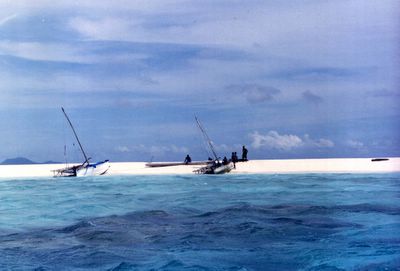 Proas on Sand Spit Proas on Sand Spit
Wings was anchored at a lonely lagoon on the outer reef in the Lousiades of Papua New Guinea, completely exposed to the elements and far from any large islands or villages. There was a small island nearby and we had gone ashore on it to burn some garbage in an old fire pit presumably left by some fishermen.
From this island we could see to another island on the next reef where there were two native sailing canoes hauled out on a sand bar. Sand Spit We took the dingy and crossed the passage to check it out. We were feeling very small in our 10 foot rubber ducky out in the big Pacific Ocean, but we got there. As we approached we saw near the canoes some men lounging on the beach watching our arrival. The water in the channel was rough and the tide was running strongly past the sand bar and out to sea. As we approached the beach we cut our motor too soon and the current caught us. Several of the men jumped up to help us but I swung my body over the side into the waist deep water and pulled the dingy safely ashore. The men relaxed.
Judy shares the beach
While I found the anchor and threw it into the sand and grabbed my camera, Judy walked over to the men and began to talk to them. They were from Kimuta Island and they had sailed to the lagoon to catch lobster that they sold to the fish buyer. Judy introduced me to the men and they showed us the big proa canoes, one about 20 feet, the other closer to 25 feet in length, made of hand adzed timber planks and ribs nailed together with long copper nails on a dug-out canoe base which also serves as a keel. The masts are small tree trunks with ½" poly ropes for shrouds and the sails are huge sections of black or blue plastic tarp's rigged lateen style. These people handle these speedy craft with skill and confidence, and they are often seen sailing in the open ocean, with four to seven people aboard, flying along in a cloud of spray and looking hopelessly over canvassed. Usually there are one or two persons bailing with a cooking pot or large shell, and one standing or sitting over the stern and steering with a paddle.
We asked them why they had come to this beach.
Indicating the younger members with them they said, "These boys have never been to this place, we brought them here to see this beach, this sand bar. Soon, when the tide changes we will go back to Kimuta."
As I looked into the eyes of these sailors, I felt a kinship to them. We deal with the same oceans, the same winds. I thought, as sailors, we have this in common.
A Man and His Ship
The Builder
Since that day I have watched these sailing canoes ply the waters around the islands, and I have photographed several of them. To me they are marvelous craft, and the people sailing them are special people. But I realize that to the islanders, the sailing canoes are just transportation, no more exceptional than the family car back home. On Bagamon Island we were at the main village with all the local people, watching a lesson on bread baking, which is another story in itself that I'll tell later, and anchored just off the village was one of the sailing canoes. I saw a man wade out to the canoe. He carried a large basket which he placed on the deck of the canoe before he climbed aboard. Then he began to uncoil lines and prepare for sailing. Soon a second man came out with a child on his shoulders. They too went aboard and began shifting cargo around. Within 15 minutes the three of them weighed anchor and set sail. Do you think the other villagers came down to the shore to see them off, or even watch from the distance as I did? No, the sailing of three souls out onto the ocean on a sailing canoe was no big event to these people, just the coming and going of some men and a child on business known to them.
Proa Sailing
Click here to see all the photos from the Louisiades
Fred & Judy, SV Wings, Papua New Guinea
Labels: Louisiades, Papua New Guinea, Proa
August 09, 2003-Ebora, Papau New Guinea
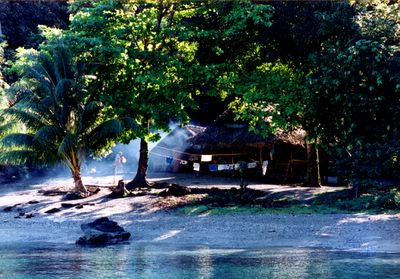 Paradise at Ebora
Sailing Down Island Paradise at Ebora
Sailing Down Island
After nearly two months in the Lousiades we're finally away from the howling wind. Tonight we are anchored in a calm place and there is not any wind outside wailing in the rigging or whistling through the palm trees. In fact all we can detect is a slight offshore breeze and the smell of smoke from cook fires and burning rubbish. It reminds us of Mexico, where we often had this smell at night. We haven't had it before anywhere in Papua New Guinea.
Kids in the Tree
We can also hear kid's voices on the beach because we are anchored right in the village. I mean "right in the village", it's that small. This is Ebora, and it isn't on the chart, but thanks to some friends who heard about it and told us to look for it, and a "mud map" we got with longitude and latitude, we found it. It's just a tiny notch in a rugged island coastline, we almost missed it, but here we are, and the native’s houses are only a hundred feet from the back of the boat, but we don't mind. It’s quiet and calm, plus there is plenty of good fresh water here to fill our tanks, so we can take baths and wash the boat, all in all, quite a luxury.
Just as we're glad we got to Ebora today.
Click here to see all the photos From the Louisiades
Fred & Judy, SV Wings, Papua New Guinea
Labels: Ebora, Louisiades, Papua New Guinea
August 8, 2003-Spinning in the Louisiades
Click any image to enlarge
wingssail images-fredrick roswold
 Grass Island, The Louisiades Grass Island, The Louisiades
In the Louisiade Islands a quiet anchorage is rare. Usually the wind blows day and night, the wind "bullets" come down off the hills wherever you are, the waves bounce you and the boat swings and rocks, and between it all, you get no rest at night.
But Hata Lawi is different. It is really quiet here, the boat doesn't move, the wind is completely absent, and all we can hear are crickets from the jungle on the hillsides which surround us in this flooded, volcanic crater which forms this anchorage. It is so quiet I can hear the faucet drip in the galley sink. That's quiet.
The stars are out, and a full moon, and Mars. It is so bright outside tonight that it seems almost like a fog of moonlight surrounds us and the bay glows with it.
Tomorrow we head back to town to check out of Papua New Guinea.
The Louisiades are nice, very nice, and Hata Lawi is special, but we are ready to head out, toward the Solomon Islands. Itchy feet I guess, but that's probably one of the reasons we live on a boat: so we can get moving when we feel the need.
The people here in the Lousiades have made this leg of our trip memorable. There have been kind and beautiful people visiting our boat in their dugout canoes in every anchorage and harbor.
Mostly they are trading.
This afternoon we were visited by a couple of young men who introduced themselves as Peter and Clifford and there were also two small boys, who all arrived in one big canoe, and said they had just finished the day's work in the garden. They wanted to sell us a "Baggie" necklace, made of sculpted sea shells. It was a lovely baggie and Peter offered it to us for eighty Kina. We've been wanting to buy a baggie, and we could have paid that price, which is about $25, but I was quiet after he asked the K80 and then I changed the subject and talked about the weather for a while and he dropped the price. He said, "I'll cut it to K30 and some trade goods". In the end we settled on K20 and the trade goods he wanted, some trousers and a t-shirt. The t-shirt we gave had a picture of Bon Marley, who is revered in these islands, and we played some Bob Marley music on the stereo for them and they toured the boat before they left.
Then Roland and his wife Flavia came by, minus their son Clinton, whom been with them when they stopped by on their way to work in the garden in the morning. We asked about Clinton and Judy wondered if he'd been eaten by a crocodile, but they said he'd gone home to the village with Peter, who was his uncle. Then Roland showed us the pearls he had, nice big pearls that would be terrific on a pendant or necklace. He wanted K50 or maybe K30 and some clothing. We have a lot of nice second hand clothing that we brought for trading and Judy picked out a red outfit for Flavia, which she liked, plus they wanted some rice and so we had a deal. We sensed that they too wanted to see our boat so we invited them aboard and gave them some juice and showed them around. They waved goodbye as they paddled off.
Often the people have some veggies like tomatoes or potatoes or some fruit, or just a few eggs. We always trade with them, and we have always had a good selection of fresh produce on board as a result of it, and they don't ask too much for what they bring. But you can tell when they are unhappy with our offers. They just look down and won't meet your eyes. Finally they agree, or disagree, and sometimes they just paddle off a little miffed I think, but it is understandable. However, we won't pay a whole fishing rig for a couple of eggs.
Sometimes the men have such specific requests that I imagine they were sent by their spouses, "Stop by the yacht on your way home and see if you can pick up a bar of soap."
Other times the people who visit just want to talk, or just to get a close look at us and our boat. When we ask them what they are up to that day they often reply, "Just spinning" or, "Going for a spin", which we figure means they aren't doing anything in particular, just goofing off.
Several times people have come by to talk about the war in Iraq. They always ask if the was is over yet, which they know it is, but it is their way of bringing up the topic. We say that mainly it is, but there is still some fighting. Then they ask if Saddam Hussein has been caught. We wonder how they have heard about this war, there are no TV's or radios, or newspapers in these villages.
Once a boy named Raymond asked if we had a magazine, and he didn't want a sailing magazine, but People Magazine was fine. He noticed Mel Gibson's name on the cover and he recognized the name and then we talked about movies stars for a while. He got a big laugh when I told him the Arnold S. was trying to get elected as governor of California. He was amused that an actor wanted to be a politician. I didn't mention Ronald Reagan to him. Once again, we are surprised at what these people know about the world.
Then there was Andrew who weaseled us out of 2 gallons of dingy gas so he could top off his 40hp Yamaha powered speed boat, who said he'd "try" to replace it the next day, but we never saw him again, and we found out that the local trade store was out of gasoline. And Sam who never gave up until we agreed to let him carve a name board for our boat so he could earn some money and buy soccer shoes, and the old deaf/mute man with a pony tail who was the only person on Pana Namura who wasn't besotted by shyness and was willing to skip rope with Judy on the beach, and he was great, and the kids at the school who belted out the Papua New Guinea national anthem for Judy, and Billum who toted water for us for a week for the equivalent of $7.00, and he couldn't even lift the water jugs; it took him and two of his small friends to get a full jug down the beach to his canoe…
They've all been wonderful.
So we wonder what the people will be like in the Solomons, but one thing we've learned from the Lousiades: if we take the time to get to know the local people, it really adds to the enjoyment of our trip.
Fred & Judy, SV Wings, The Louisiades Labels: Louisiades, Papua New Guinea
August 07, 2003-Child singing in the night.
There is a rock wall off to the left of our boat where we are anchored at Ebora cove, which is so steep and rugged that I don't see how anyone could walk on it, let alone do it in the dark, but a small child does each night, and she sings. The whole place here is so tiny that we are only 50 feet or so from the sheer limestone outcropping, so we can hear her clearly, even though her voice is soft.
During the day there are many children on the beach at our stern, and up high on the cliffs or jungles above.
But at night there is only one, a small child who we have never seen, but whom we hear singing in the darkness each night somewhere on the rock wall near the boat. Her voice is gentle and beautiful and she sings in some local tongue which we cannot understand, but if we come on deck at night, we can hear her.
It is a wonderful thing to hear and experience, this child singing in the night.
I don't think she is singing to us. I think she is singing to herself, and we are just eavesdroppers.
Hearing her makes me wonder about her life, her hopes, and dreams. She comes away from her home and family each night by herself and finds her way to this cliff where sings her gentle song, alone in the dark. What is going through her head? Is she wondering about her future, trying to make sense of the world, or just going over the day's events? I think about what future she might have in the village, when she becomes older and marries. When there are children to tend and a house to keep, will she still have her dreams?
All over the world I know there are children who struggle to understand the world around them, who feel hunger, or are sick; each one a unique person who sees the whole world just through their own eyes. The wonder of this, and the immensity of it, touches me.
The children are not always sad. In fact they are mostly a happy bunch. Here at Ebora it is mostly the children who make this place a delight for us. They come in groups during the day to watch us or shout for balloons (to which we answer patiently, "Balloons finished", or to sing. There is a tree, or the remains of a tree, leaning out over the water, all gnarled roots and broken limbs, barely hanging on to the spongy limestone rocks which themselves are barely hanging onto the cliff, and the village girls come to it during the day. Five or ten or twenty swarm on it and look down into our boat. They chatter like monkeys. We wonder how they keep from falling off onto the rocks below, or why the tree itself does not fall off. We also wonder at the timing of their coming and going. How do they decide it is time to go to the tree and watch the Dim Dims (us)? What makes them all at once pick up and leave?
Of course at any given moment we may hear a small voice at the side of our boat, and there will be one of the village's shared canoes with one or more boys in it. They bring some bananas or other fruit and ask for things, like exercise books for school. Judy will always trade with them.
At other islands the men have come to trade or ask for things, or in some places, women. But here at Ebora, only the children come out.
In addition to the girls who come to the tree, and the boys who come out in the canoes, there is also a group of little boys around here who hang out together. They are smaller than the girls of the tree, maybe three or four years old. They are all naked and brown, and they are boisterous. They shout at us quite assertively and throw rocks at the girls (just out of range, thankfully) or three of them climb up on some planks and do a little dance choreographed by a fourth, singing. They have a rock they climb on also, but it is to jump from, not for watching dim dims. And during the day we hear the sound of the plunge of their bodies into the water, mixed with the jungle sounds of birdcalls and cicadas and the lap of the waves on the rocks, and everything else which is going on in this village where we are staying.
There is a lot of sound here, but at night, there is just one small child singing
Click here to see all the photos from the Louisiades
Fred & Judy, SV WINGS, Papua New Guinea Labels: Louisiades, Papua New Guinea
July 5, 2004-Arrival In Papau New Guinea
Our last night at sea on the way into Papua New Guinea was hairy; it was dark and dirty with low clouds and no moon and the wind blew a gale and the waves were huge. In those conditions we were blown through the night towards our destination, the narrow, unmarked marked reef entrance to at Dumaga Harbor on Sudest Island in Papua New Guinea's Lousiades Islands. It was no place to arrive at night. No way would we approach the reef system of the Lousiades in darkness. For one thing the charts were known to be inaccurate, the reefs to be treacherous, and the pass narrow. For another, we could see nothing, it was totally black.
So as the gale drove us onward and we became too close and it was still hours before daylight we dropped the jib and hove to. Even that was unsettling; stopped in the darkness, in a howling wind on a rough ocean, unable to see anything, waiting for daylight. It still made our stomachs churn and we just held on, trusting our navigation and hoping not to hear the crash of nearby surf or the impact of our keel on a reef. We prayed for the dawn to come so we could make a safe landfall.
And then the sun came and it was a welcoming sight.
The excitement was not over yet though, even in the daylight we had a wild arrival, blowing through the pass in the reef with the left over swells of the Coral Sea breaking on either side, and then in the calm water inside the reef, navigating to the shelter of Dumaga Harbor with the poor visibility of solid cloud cover; it was tense. But we crept forward, and finally the hook was down and we breathed a deep sigh of relief and then toasted ourselves on a successful, if unnerving, passage.
As we folded the sails and put the boat away we looked around. Dumaga Harbor was a good anchorage, bullet proof with plenty of room and good holding. What we didn't see however were any sign of human life. No boats, no houses ashore. Well, none of our guide books even mentioned this place, so what would we expect, a crowd?
But then we noticed a few wafts of wood smoke drifting down from the hill above our anchorage. Someone was burning something in back of the harbor. What, we couldn't guess, but it meant there were people here. When we scanned the shoreline with our binoculars, we saw a dugout canoe or two pulled up under the trees, and a few roofs showed through the palms.
wingssail images-fredrick roswold
 Dumaga Bay, Sudest Island, The Louisiades Dumaga Bay, Sudest Island, The Louisiades
Apparently there was life on Sudest after all. We launched the dingy.
Click here to see all the photos from Papua New Guinea
Fred & Judy, SV Wings, Sudest Island
Note: Sudest Island has other names; some maps call it Vanatinai, others call it Tagula. Out chart called it Sudest.
Labels: Louisiades, Papua New Guinea
NEXT Page (More)
|


.jpg)

