December 6, 2003-Leaving the Solomons
 Judy JudyToday at 13:00 we passed out of the Vela Gulf, where Kennedy became a hero after the sinking of PT109, where last month nature gave us a wake-up call in the form the white squall, and where we have often sailed on this Solomons cruise, but today we only motor. There are no white squalls today. This is a windless day, a hot and humid and airless day, through which we drone under the power of our diesel engine, sails remaining furled or stowed below still in their bags. What slight breeze there is is with us, at our exact speed and heading, and the cups of the anemometer have hardly turned a single revolution the whole day. We swelter. Below decks we lie around naked in front of a pitifully weak fan, on deck, wearing little more, we find a shady spot, and wish for wind. WINGS is ready to sail, ready for sea. The anchor is stowed and the chain pulled aft, this dingy is put away, and the lee clothes have been rigged. Even the jack lines are attached to the deck ready for our safety harnesses. All we need is some wind, any wind. But no, we continue to motor. After Vela Gulf we turn left, into The Slot, where the Tokyo Express steamed at night in 1942 and 1943 to assault and harass the American forces on Guadalcanal. Today there are no warships or even any canoes steaming The Slot, just WINGS plodding slowly to the Northwest towards Bougainville, on her way out of the Solomons. During the afternoon we pass the Ulo Thermal Zone on Vela LeVella Island, and see the gray steam and smoke rising from the jungle up at the crater where once we slogged, ankle deep, and sometimes knee deep in sticky red, rainwater cool mud on our way to see the bubbling hot red volcanic mud and smoldering trees of the thermal zone, where the guides watched our every move lest we stray more than a foot from the path and step onto the softer surface where we would instantly sink into the super heated slime, ruining everyone's day. Behind us, fading from view, is Gizo, that wild west town we learned to love, and the cluster of cruising boats which remain there, VELELLA, DJAPANA, CALIFIA, and NATIVE DANCER, the crews of which are friends of ours whom we are now leaving, and who we will dearly miss. Also behind is JOLIGA II, anchored safely where we left her at Liapari Island, waiting for John Sloboda to recover from his illness and return, or sadly, to perhaps await a new owner…we don't know the answer to that one.  Gizo Dancing Group Gizo Dancing GroupAlso behind us are our new friends among the expat community in Gizo, Danny and Kerrie from the dive shop, Joe and Lisa from Lola Resort, and Gareth and Rebecca, and Patrick and the other westerners who choose to live in this out-of-the-way corner. Behind us is the Gizo Hotel and happy hours spent there drinking Sol Brew beer. And most of all, behind us are the Solomon Islanders, those dark and usually happy Melanesians who laughed and sang while they paddled past our boat in their dugout canoes, or drove their long boats with the big Yamaha motors at reckless speeds while standing at the back with shirts or hats blowing in the wind, or walking, standing sitting, lying all over the town of Gizo, filling the market with fresh food, their canoes with freshly caught fish, and the air with their pidgeon words and laughter. We'll miss the Solomon Islanders, and the Solomon Islands, as we move on westward, on our continuing trek.  Kolombangara, The Solomons Kolombangara, The SolomonsFred & Judy, SV WINGS, at sea. Labels: crew, Gizo, sailing, Solomon Islands
November 22, 2003-Tales From The Solomons
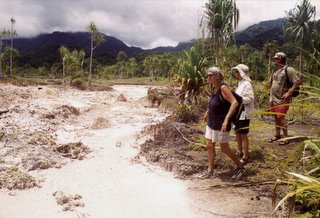 As it often does with us, inertia has set in. We'd planned to spend November cruising in the Solomon Islands, to Morovo Lagoon, or Choisol Island, two interesting cruising grounds, but instead, other than short trips around the area for snorkeling and exploring, WINGS has mostly remained anchored in Gizo. Tonight is an exception. As I write this we are anchored in a small bay on Vella Lavella Island, about 25 miles from Gizo. This is just a weekend outing for us, we'll go back to Gizo on Wednesday and we are planning a Thanksgiving dinner with some other cruisers there on Thursday. But meanwhile we are in a very pretty bay with rain drenched and mist shrouded mountains on one side and a ring of islands on the other, and the local people sing as they paddle their canoes around. Their beautiful voices and a few tropical birds are all that break the stillness of the place. Since no other yachts have visited this bay for a few years, we are drawing quite a bit of attention. All afternoon there have been a cluster of canoes around us, with local people in them, just quietly looking at us. We talk with the few who come alongside, but mostly they don't have much to say, or can't speak English. After a few hours of this we retreated below to escape the stares We are here to visit a volcanic area nearby to see some thermal eruptions, and our friends on Vellela and Caledonia may meet us here, plus we wanted to get out of Gizo to a place where there was clean water so we could swim and scrub the bottom of the boat, but it turns out that this is not one of those places. Why? Because of crocodiles! The first native to visit us who could speak good English is the Chief of the village, and he warned us against swimming, saying that there were plenty of crocodiles in the bay. That settled that. But, while we've been hanging around Gizo, we've been enjoying life, taking it easy, with friends from the few other boats around. Actually there have been quite a few boats around and once last week there were ten here including four from Seattle (well, sort of). First it was us, then Garth and Wendy on Vellela, fellow CYC members from Seattle, arrived, and then Josh and Nelia on Caledonia, a nice Cal 40 home ported in Port Townsend, and John Sloboda's Joliga II. Although John hails from Sparks, Nevada, his boat, a Ranger 30, was made in Kent, Washington. A sad story about John: He has been very ill and has been flown to Guam, and possibly on to Hawaii for treatment of a badly infected foot. First he went to the local hospital and they decided it needed an operation they didn't feel they could do, so John had to leave his boat and seek better medical facilities abroad. We've been looking after his boat and getting it ready for a long-term stay until he can come back While we have been in Gizo we have had some serious computer problems and I have had my head down working on them, and maybe I've been doing a little too much of that. Yesterday morning a local wood carver named Simon stopped by to show us his carvings, (this is a frequent occurrence in the Solomons). I really didn't want any carvings but I came up on deck to be polite, meanwhile wishing that he would just go away so I could get back to my computer. Then I realized that maybe I had it all wrong: here I was, in a beautiful island setting, talking with a pleasant and articulate local artisan, and all I wanted to do is work on the computer. Probably I had my head in the wrong place. So I stayed on deck and offered Simon a cup of coffee and "storied" with him a while. He told me some of the cultural history behind the carvings and about his family and it was a good break. And…I bought a small carving. After Thanksgiving, and the as soon as a new computer and some boat parts arrive, we'll finally break free of the inertia and set off back to Papua New Guinea, this time New Ireland Province, on our way to Palau. Fred & Judy, SV WINGS, Solomon Islands 07 degrees 41.4 minutes South Latitude 156 degrees 45.3 minutes East Longditude Labels: Gizo, Solomon Islands
October 31, 2003-White Squall
 We were sailing north in the Vela Gulf on our way to Vanga Point under the shadow of Kolumbangara, the extinct volcano known to be the home of gods whose name means "Rain King". We were happy to have wind and were wishing for more to pull our fishing lines faster but Wings was already powered up under full sail. I lazed away on deck with the wind vane steering waiting for a fish strike and Judy was down below reading. To our right the peak of Kolumbangara where the gods reside was shrouded in dark clouds and rain fell steadily on its sides but out in the Gulf it was a nice day, and we were carefree, glad to be sailing for once instead of motoring around the Solomons. The gods on Kolumbangara watched with displeasure at our disregard for their power as we sailed by without even a glance their way. They sent out a few threatening rain squalls to dance around the shores of the extinct volcano but on Wings we took no notice, and simply sailed on. The gods then sent out one dense cloud of rain that obscured the mountain itself from our view, but we only watched its approach with slight interest, wondering if we'd get rained on. Then the gods got angry. They sent a white squall. The squall approached Wings with stealth, behind the rain. The wind, when it came, increased but slowly. I noticed the strengthening wind and, as Wings picked up speed under the press of canvass, I adjusted the wind vane and cranked in the sails. The wind went forward, backing, as it built. I was happy; this was sailing! Then the wind and rain hit with a vengeance. From 18 knots it became 22, then 26, then 30, and higher. The rain pelted down and Wings surged ahead, fishing lines singing and with a quarter wave that roared. I could see nothing around us but whiteness. The boat became overpowered with the big main set deep and full and still eased a bit out, and the boat began to round up as the wind vane struggled to maintain control. I reached for the helm and disengaged the control lines to the vane, and as Wings heeled sharply I pulled the tiller up to my chin. I looked aloft and the big main was luffing along its full length, undulating like a living thing, then waving, like a flag. Another gust hit and we rounded up more and the gentle waving turned into to a violent shaking. The mast and standing rigging and all the sheets tried to rip free of the boat and go with the wind. I wanted to run off and settle the main but I needed some more hands to ease the sheets while I steered. Judy was on deck by now and saw my difficulty and she jumped to the mainsheet winch and let out enough for me to turn the boat down. The shaking stopped as the sails filled again. Now we ran off at 8 knots. The sea swept past in a rush and the rain hit our bare skin like lead pellets. Somewhere ahead in the mist were the reefs of Vella Lavella Island. The wind settled at 33 knots, still plenty strong and Judy took over the helm as I flattened the main and dropped the jib. We knew we should reef but downwind that would be difficult and we didn't want to take the time, not with Vella yet ahead. With the main still fully hoisted but now flat as a board, and the jib secured on deck, we turned upwind and sailed back in the direction of Vanga, now slowly and in full control. The gods on Kolumbangara saw that we were paying attention for once and they were pleased. The squall passed. Fred & Judy, SV WINGS, The Solomon Islands Lat 08 deg 05 min S, Lon 156 deg 50.2 E Labels: Gizo, sailing, Solomon Islands, storm
September 24, 2003-Tony the Greek
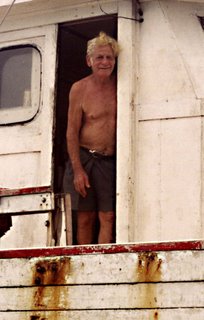 Tony TonyWe first ran into Tony when he stuck his face out the pilot house door of an ancient islander trader in Gizo, Solomon Islands. We were sitting alongside his vessel in our dingy giving one of his crewmen a ration about dumping oil in the bay. "What'sa problem?" he asked disdainfully. "You're dumping oil into the harbor!" I said, as I eyed the slick leading out from his boat towards Wings, anchored across the bay. "So whats'sa matter, we're pumping dah bilge, you always get a little diesel when'a you pumpa dah bilge. It'sa only diesel! What's you wanta me to do?" This exchange went nowhere for another minute or so and then we motored off in our dingy, convinced that "Tony" would pump his bilges as long as he felt like it, and would, in fact, pump the whole Arabian peninsula into the sea if he could, and never worry a smidgen about the consequences. Two nights later I saw him in the bar at the Gizo Hotel ordering a couple of beers and I decided to make peace with the man. I went up to him, introduced myself, shook his hand and said I hoped there weren't any hard feelings about what I said the previous occasion. "No, I no giva it another thought." He said. We talked for a while and I observed the man. Old and deeply wrinkled, he had a face full of warts and beady blue eyes buried deep under a thick brow. He had a big WC Fields nose, and a mop of unruly white hair. Wearing a dirty red short sleeve shirt which stretched over a small round stomach and dirty white shorts, he was altogether an unpleasant looking fellow, quite intimidating when I'd been looking up at him on the deck of his ship, not so intimidating now in the bar at the Gizo Hotel. But he was an interesting man, a white man in a black country, the kind of mysterious expatriate you meet on a dusty street in a remote part of the world, where most other people you meet talk pigeon and call you "boss", and you wonder how he got there. I decided Tony was a loner, an expat who's gone bush long ago, working on native boats with native crews for native owners, driving old rotting wooden ships around the islands for as long as anyone can remember. Maybe no one around here knows his story, I sure don't, but he has one you can be sure, something in his past or personal make-up that resulted in his choice of a life on the edge of the world. As we talked Tony warned me about the natives, said never to trust them, they'd steal you blind, and told me not to leave our boat un-attended. I guessed Tony had learned these lessons the hard way. I wondered about his background and I asked him if he was Italian and he said, "No, Greek." I asked him if he was the captain of the ship and he said, "No", and indicated a Solomon Islander sitting alone at a table nearby, saying he was the captain. Then he said, "Don'ta look, He'sa gonna think we're talking about him." We walked over to the table and there was a lot of shaking of hands and I sat down and talked to both men, but I didn't understand much of what they said, and less of what was really going on, and I never figured out exactly what their relationship was, but it definitely included some rivalry and mutual suspicion. Maybe Tony was there to keep the ship from being wrecked, but the other man, for political reasons, was officially the captain, but that was never clear. They each cornered me alone however and said they'd come to WINGS the next day to explain the whole situation, to tell me the real story; but the next morning their boat was gone from the harbor, and both of them with it. I don't know when I'll meet Tony the Greek again, but somehow I know I will. I'll see his ship, and there he will be, in some other hot, dusty, remote town in this forgotten part of the world. Meanwhile, I know he's out here, doing his thing, and he will be until he dies, probably some moldy jungle hospital somewhere, alone. Fred & Judy, SV WINGS, Solomon Islands Labels: crew, Gizo, Solomon Islands
September 18, 2003-The Solomon Islands-A New Country-A New Time
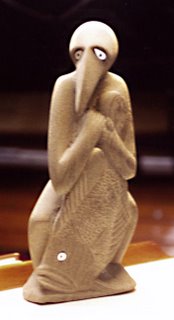 Solomon Islands Stone Carving Solomon Islands Stone CarvingWe left Papua New Guinea after a stay of two and a half months. The Lousiades were great, and we could have spent more weeks there and still not seen it all, but it was time to go. The anchorages and islands of the Solomons were enticing and the clock was ticking towards January when we would be heading north across the equator. If we were going to see anything in the Solomons, we needed to move on. At dawn on the 13th of September we weighed anchor in the Budi Budi atoll and set sail to the North East. The passage was uneventful, close hauled sailing in light to moderate winds, and WINGS performed as only she can, steering finely on the wind vane and making great time to windward. We arrived at Gizo, 8 degrees 6 minutes S. 156 degrees, 50.3 minutes E. at 1:30 the next day, three hours ahead of schedule, having sailed 202 miles in 31 hours. We hoisted a Solomons Islands courtesy flag and the yellow quarantine flag and had a cool drink. We'd arrived in a new country, for a new adventure. (We've visited the Solomons before, if briefly, in 2002, when we sailed in the Santa Cruz Islands, which are part of the Solomons, for a week.) Before long we were on the dusty streets of Gizo, taking in the sights and marching to the Customs office. The place is fascinating, as is every new place to us, packed with black Solomon Islanders and brown Gilbertese, the Micronesians who have been settled here in years past, and a few, very few, white people, mostly expat Americans, except for three very lonely and bored Australian police sent here as part of the Australian led intervention force. They don't have much to do. The stores, mostly run by Chinese, are of the "general store" type, which you might expect to have seen in 1920's. 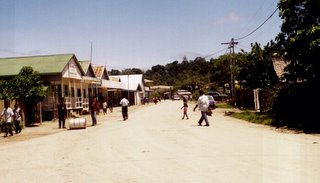 Gizo GizoThere are a few private cars and trucks, and eleven of the most beat-up taxi's you can imagine. But they don't have to be very good to attain the maximum speed of 5 miles per hour, which is as fast as you can go on the street crowded with people and full of potholes 8 inches deep. There are however, about 500 panga type speedboats and much of the transportation here is by water. (The airport is on an island; you take a water taxi to and from it). Parking spots for cars on the street are easy to find, but parking on the waterfront for boats is at a premium. Gizo is the tourist center for the Solomons, but for the last few years that isn't saying too much. There has been a "time of tensions" in the whole country, marked by violent clashes, crime, and a breakdown of government function. The Solomons have been reputed to be a dangerous place visit. There used to be 200 yachts a year stopping in Gizo, now there are less then 10, and mostly those are just passing through. The economy has been in tatters. But it is a new time for the Solomon Islands. An international force of military and police, led by the Australians have landed, rounded up some of the worst bandits and killers and have restored order. They are also in the process of rounding up a bunch of really corrupt politicians. Many people think that Australia will have to virtually take over the country before they are done. Some other countries in the region are concerned by this, knowing that their own houses are not in order, but in the Solomons, it seems to be a welcome change. In Gizo, people are hopeful. Maybe tourism is coming back. The dive shop has been busy and there are now three yachts anchored in the harbor. People are upbeat. There is new construction going on. We are excited by the cruising potential here. With no cruising boats here for several years, the place is relatively untouched and there are hundreds and hundreds of promising anchorages to try. We'll be reporting to you about whatever we find in the Solomons, and if you are looking for an unspoiled hideaway, you'd better book now. This place could take off. Fred & Judy Labels: Gizo, Solomon Islands
September 14, 2003-Night Passage to Budi Budi
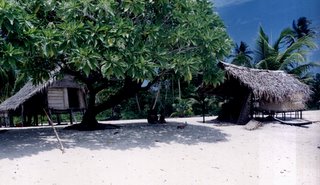 An island near the equator, white sand beach, two miles long, maybe, backed by palm trees and jungle foliage, and through the gaps, the blue ocean beyond. There are thatched huts on the beach, and we can hear the children laughing and playing in the sea. Where we are anchored, one half mile offshore, but within the protection of the reef and lagoon, there is calm azure blue water and a mild trade wind breeze blowing though our hatches. Nice, very nice. This is Budi Budi, 9 degress 17 minutes South, 153 degrees, 41 minutes East, the farthest outpost of Papua New Guinea. We arrived here this morning after a night passage from Misima having left the port of Bwagaoia at 5:00 pm the night before. Dusk found us beating around the eastern corner of Misima Island, and then we bore off and settled down for the long reach up to Budi Budi, 100 miles distant. With the wind vane steering, and a nice steady breeze, there wasn't much to do on our three hour watches except wait for the moon to come up, and when it did, we had light. A good sail. At dawn we felt our way into the lagoon at Budi Budi and dropped anchor off the village. Several canoes came out while we were anchoring, and several naked boys on foam boogie boards paddled up, and after we anchored one man introduced himself as William. "Hello" I said as I leaned over the side to shake his hand, "Nice to meet you. Can we stay here?" "Yes", he answered. I told him we wanted to eat and get some rest. He said, "OK", and they all disappeared. We had the day to ourselves and we napped and swam off the boat in warm, crystal clear water. In the distance we could hear the surf pounding on the far side of the island. Tomorrow we'll go ashore on Budi Budi.  MV Muyuwa, Local vessel returns from Woodlark Island, 40 miles distant. MV Muyuwa, Local vessel returns from Woodlark Island, 40 miles distant.Fred & Judy, SV WINGS, Papua New Guinea Labels: Budi Budi, Gizo, Papua New Guinea, sailing, Solomon Islands
NEXT Page (More)
|


.jpg)

