September 5, 2014-One lap of North America
wingssail images-fredrick roswold
 Somewhere East of Bakersfield Somewhere East of Bakersfield
Somewhere East of Bakersfield in the Mojave Desert lies China Lake Naval Air Station and there we slid our Chrysler to a stop in front of a red stucco apartment where our granddaughter Candace answered the door and offered us an orange flavored craft beer. More importantly she gave us each a big hug and as we sat down to chat we were delighted to find that in the previous four years she has turned from a sharp navy boot to a confident and composed 29-year old woman.
 Family in Twin Peaks Family in Twin Peaks
This has been the story of our 7500 mile loop in America; at each stop we have found that our family and friends have grown up, matured, and changed from the wonderful people we remembered into delightful people even more wonderful than we could have ever imagined. And our timing was good, for family events and tourism too. We got to Seattle just in time for the birth of our newest granddaughter, Helena Anne, we made it to Oregon for Jenny and Gabe’s wedding, we were in San Diego in time to be with the Waldrups as they celebrated the life of Aunt Levis. We even hit Sturgis South Dakota for the great motorcycle rally.
 Gabe & Jenny's Wedding Gabe & Jenny's Wedding
So, so far, the trip it has been a success; we’ve spent quality time with my brother and sister, son and daughter, and all of their families. We’ve been together with most of Judy’s family, and we’ve reconnected with many of our friends, particularly ones we missed last time we were in the US. The car is running well, and we completed all of our shopping and bought everything on the boat list. Even the weather has been great. From Oregon south we’ve barely had a cloud in the sky, but it’s been hot; in San Diego it was over 100, and in Indio, California we had temperatures over 112. Never mind that, in the low humidity of the southwest desert, it didn’t seem too bad.
Now we’re back in Mexico. We drove through the Sonora Desert and it was stunning. We visited Mazatlan and boy has it changed; the marina area has been totally built up and then been run down. Now there is a tacky air about the marina which might cause us to reconsider whether we will bring the boat there. We’ll see.
We stopped in small towns like Tecuala, and in old cities like Cuidad Obregon, Morelia, which was historic and gorgeous, and Oaxaca. We had great meals in outdoor restaurants on centuries-old plazas. We dropped into the Valley of Mexico and struggled through Mexico City traffic for hours. We had been in Mexico City before and could have by-passed it but we wanted to experience the size of hemisphere’s largest city by driving through it and we did. Whew! Big!
Yesterday was the toughest drive. After the hours of Mexico City we finally broke free of the gridlock and climbed from the city’s 7500 ft altitude up into higher Sierra Nevada on a four lane freeway with sweeping curves and traffic moving faster than we were comfortable with, but you have to go with the flow, right? Then down the other side into Puebla with more curves and even higher speeds. The driving was tense and definitely tended to focus the mind. But too, it was exciting.
 Oaxaca Oaxaca
Because of the traffic jams in the Valley of Mexico we were behind schedule and to get to Cordoba where we had reserved a room we had to drive into the night. In the last set of mountains we had fog, rain, road construction everywhere, poorly marked lanes, and darkness. It was exhausting, but we arrived safely in Codoba. Today we had another exciting day in the mountains with more stunning scenery and arrived in Oaxaca this afternoon.
 Sturgis Sturgis
Tomorrow we hope to be back at Marina Chiapas and back onboard Wings.
We have been driving long days and stopping rarely so there are few photos of the trip, but we have some of the people we stopped to see.
Click here to see photos from our lap of North America
Click here to see Gabe & Jenny's Wedding
Click here for photos from Sturgis.
Fred & Judy, Oaxaca, Mexico
Labels: Family, friends, Mexico, USA
August 03, 2014-On The Move Again
 Palace of Fine Arts, Mexico City Palace of Fine Arts, Mexico City
We loved Chiapas so well...
We left.
Monday we took a bus to Tuxtla, (great 6 hour bus ride and crummy dinner in Tuxtla Guiterrez.)
Tuesday we flew to Mexico City, (great dinner in Centro Historico, and stayed where I always do, for the last 32 years, at the Ritz; they gave us a suite for our loyalty.)
Wednesday we flew to Cleveland, Ohio.
Thursday we bought a used car, (Chrysler 300) and got USA phone cards.
Friday we drove to Iowa, where we are now (at Judy's niece Angie's house in Cedar Rapids).
Looks like we will drive to Seattle on Monday, or start anyhow, and visit relatives and friends in Washington State, then later in August go to Jenny’s wedding in Oregon.
Finally, after we pick up the new mainsail somewhere on the West Coast, a drive to Mexico and down all the way to Chiapas.
You can cover a lot of ground if you take to the air, and even by land you go faster than a sailboat
We’ll check in along the way.
 Our New Ride Our New Ride
Click here for more images.
Fred & Judy, Cedar Rapids, Iowa
Labels: Angie, Chiapas, Chrysler 300M Special, Mexico, Mexico City, Tuxtla Gutierrez, USA
May 25, 2010-Family Photos(& Friends)
May 23, 2010-Washington State
April 29, 2010-Heading West
 Heading Out Heading OutOn Saturday we left Cedar Rapids Iowa. By Sunday we were passing through Denver. The trip across the great plains took a day and passing through the Rockies took another day and then we detoured across the Colorado Plateau, the source of the Rio Grande and Colorado Rivers, had lunch in Taos New Mexico, and dropped down with the Rio Grande to Albuquerque.  Truck Stop Truck StopAt sunset next day we were on the South Rim of the Grand Canyon and we stayed that night at a lodge right in the park. At 05:30 the next morning we got up to shoot the canyon at sunrise.  Judy At the Grand Canyon Judy At the Grand Canyon Rain Comes to the Canyon Rain Comes to the CanyonAt 7400ft of altitude the South Rim is high enough to be damn cold in April and a front coming through brought an icy wind. We shivered behind a rock doing arobics to stay warm and took a few photos whenever the sun came out but by 07:30AM the rain and sleet and chilly conditions drove us off the rim of the canyon and we took the shuttle back to the lodge, had breakfast in the cafeteria, and then headed down the mountain. That afternoon we arrived at Jan's house in Indio California (Palm Springs) for a wonderful few days of family fun & desert heat and completed our roundtrip by pulling into Margie's driveway in San Diego 35 days and 6000 miles after we started. Next we will fly to Washington State to visit the other side of the family.  At La Jolla At La JollaClick here to see some photos we took coming back across the US. Click here for shots of the Grand Canyon Click here for photos from Ocean Beach in San Diego Click here to see the Silver FoxFred & Judy, San Diego California Labels: USA
April 10, 2010-Back in the USA
 Pensacola Beach Pensacola Beach
It was time for a trip back home, as they say, so in late March we closed up the boat and headed to the USA.
After a short layover in Hong Kong we launched off on the midnight flight from Beijing to LA, took the Amtrack to San Diego, picked up Judy’s sister Margie (and her car) and headed to points east with the cruise control set on 85. I love driving in America.
And we crossed the whole dang continent already.
Oh we’ve had a good trip so far: the desert was great, awesome, and incomparable; the French Quarter of New Orleans was neat, as were the other stops, and seeing family members at various cities along the way has been fun too.
 Racing the Train Racing the Train
Then there were the adventures:
Like trying to learn the GPS Navigation computer Jan and Howard lent us. (How do we get this damn thing to shut up and why does it keep telling us to do a u-turn?)
Like running out of gas in a dodgy part of Houston and barely coasting into a gas station on fumes and we wouldn’t have made it at all except for the quickly punched-in destination of “Nearest Gas Station” which directed us right to it (thanks Judy for your quick action on the GPS). I had to push the car the last 50ft which was quite a chore until Margie reminded Judy to take her foot off the brake; then it got easier.
Like when Margie lost her cell phone and we decided to call her number so we could see if we could hear it ring, and then all of us spent 10 minutes going through luggage trying to find her address book with the phone number, which she didn’t know, only for her to tell us when we finally got the number and dialled it, “Well it isn’t turned on anyhow.” (Now you tell us.)
Like in the Galveston Ferry line when we ignored the honking behind us for the longest time while I was taking pictures out the car window until we realized that it was us they were honking at. All the cars in front of us had boarded the ferry and the folks behind us were a bit peeved at us for not moving. The red-neck guy directing traffic called us “Fruit Pickers” due to our California plates but then he said, “OK Bud.” and waved us onto the ferry.
But we made it and now we are in Pensacola, Florida soaking up sunshine and southern culture. We’ve had fried catfish, been to a stock car race, and met more relatives than I can count, and they all live in about a 3 mile radius.
There's lots more to come on this trip and on Monday we’re heading to Iowa to see some more family members.
Stay tuned.
Click here to see us in Beijing.
Click here for some shots along the way from San Diego to Texas.
Click here to see our Houston relatives Sherry and JB.
Click here for a glimpse at New Orleans by night.
Click here for scenes in the deep south.
And click here for some family photos.
Fred & Judy, Pensacola, Florida
Flew in from Beijing on the China Airline
I'm back in the USSA
Been away so long I hardly knew the place
Gee, it's good to be back home
You don't know how lucky you are, boy
Back in the USSA, yeah
(Apologies to John, Paul, George & Ringo)Labels: Family, USA
Avalon Harbor, Santa Catalina Island, California
October 1996-Tonight we are in Avalon Harbor, Catalina Island.
We are on a City of Avalon mooring, $20 a night. The shore boat cruises around picking people up and dropping them off at $2 a whack (we use our dingy instead), the church bells toll each half an hour like some giant grandfather clock, and the town is lit up like Christmas. I love this place, and I'm not sure why. I feel like I'm in the middle of Disneyland, it's Friday Harbor on steroids, but it's great. Today we walked all over town and of course there are all the touristy shops and rich homes, but also there are the honest touches of history like the building housing the Post Office and hardware store; it looked right out of the 20's. And I like the narrow streets, this is California but it seems more like some part of the French Riviera. This is also a place of boats. The police are more apparent on the harbor than on the land, with two or three harbor patrol boats cruising all the time, and the operators have policemen's badges. There are ferries coming and going, dozens of launches and dingy crossing every which way, and nearby launch BEN WESTON, a 50 foot open boat, tools around carrying passengers to and from we never could figure out where. The harbor is busy, pretty, and very clean. The water is as clear as glass. This afternoon we sat on WINGS having a drink and soaking in the atmosphere, the sky was blue, the sun was warm, flags were flapping, and all around us were the snorting sounds of launches and taxi's. I took some photos but the reality of this place, the way I felt, I don't have enough film to capture it. Some of the pleasure I get from Avalon could be the contrast from yesterday. It was Hell! We were in the Channel Islands, moving from one anchorage to another on Santa Cruz Island. Our First Anchorage in The Channel IslandsFirst we went into Little Scorpion, or what we took to be Little Scorpion based on our poor charts, having intended to stay the night in that harbor, but then we went around to Big Scorpion on account of the pelican rookery on the rocks up wind from the former location and the great obnoxious smell the presence of what looked to be several thousand of the big birds lent to the area. Though the air smelt better, Big Scorpion was a disappointment to us as well, and a more desolate place we could hardly imagine. The higher parts of the island were rolling hills which were totally barren except for windswept brown grass and in the valley, an extension of which became the cove as it reached the sea, there were just a few trees, some houses and a couple of beached skiffs. All these signs of humanity were vacant and run down, and were veiled in a wind blown haze or mist. There was not a person or even a dog to be seen anywhere. Surrounding the ranch, if that’s what it was, were other ruins of all sorts, old pier footings, broken fences, overturned picnic tables, and the like. Anchored in the harbor, which was whitecaps and spindrift, was a large power boat, but no sign of life was on it. On top of it all this was only a small harbor, just a bight in the coast, hardly any shelter from the open channel, and surrounded by rocks. No lights, no sign of life, no sounds but the wind. But it was getting dark and the fog was worsening and there were no near alternatives, and so we anchored in a silent, cold, choppy spot, watched the fog blow in, and wondered why we ever came to the Channel Islands. Just after dark all hell broke loose. The fog closed in completely and the wind began to howl right down the valley towards us. The bottom was rock, and our 45 lb plow, even on all chain, started to drag. We noticed right away, and sprang up from the dinner table, onto deck in our light clothes, and weighed anchor, just a few seconds before we would have gone onto the rocks to leeward. We tried to reset once, but it wouldn't do so there was nothing but to get out of Dodge. Now, like a miracle, there was a light on the powerboat which helped us get our bearings, and we motored into the darkness using that light and the compass course of escape which we had noted on our arrival. With the light on the powerboat and our compass course we made it to deep water. Without those two points of refernce we'd have been lost because in the chaos of darkness, wind and fog we were completely disoriented. Once away from Santa Cruz Island and Scorpion anchorage, we secured for sea, which took an hour after our hasty departure, and we determined that our best action was to cross the 70 miles to Catalina. Really, there was no other choice. The other harbors nearby were all small, barely protected, surrounded by rocks, exposed to surge, and fogbound, and it was darker than the inside of a coal mine. So we threaded through Anacapa passage on GPS and set sail to the southeast. We reached Catalina at daybreak, and found it quiet, clear, and warm. So now you know why I'm feeling happy to be here. WINGSWell, that's our story for the day. Life cruising continues to be an adventure. But we love it all and if we survive, we'll have a richness of experiences that you can't buy. Fred & Judy, SV WINGS, Avalon Labels: california, Pacific Coast, USA
September 28, 1996-Leaving Monterey
I still find that the Pacific Ocean has the power to make me afraid. When it’s getting late and the wind is up, or building, and we are thundering towards darkness…I really have some anxiety. At those times I just want the wind to get light and things to be easy, but that doesn’t always happen. This passage started off badly and got worse. I wrote the following passage in the log: “For a while tonight I thought it was going to be another dirty night. At 21:00 it was getting dark, the wind was 27 and building, the waves were big, and it was as cold as the Pacific always is on this coast. No moon, no stars, not a fun prospect. But the wind dropped a little. Now it’s only 22, and I’ve seen less than 20 a time or two the last half hour. Still dark and cold, but if it stays like this I’ll get some sleep when my shift is over. If it gets too wild neither of us can rest, we just lie in our bunks listening to the noise and worry too much. Now we are under a full main and no jib and the boat likes this. The monitor is happy and we’re going in the sixes and sevens. Hit eight when the wind was up. It’s fairly quiet out, no roaring surfs. Fine with me.” Slow start.Sailing from Monterey at noon under a low marine layer, we tried to beat to windward out of the bay while we cleaned up and made ready for sea. A few of other sailboats were also out and we crossed them tack on tack. WINGS wasn’t sailing well and I was feeling frustrated and cranky. One other sloop, a white boat of about 40 feet, was being well sailed was making moves on us. I snapped at Judy. It didn't help. Eventually we found a groove and began to put some distance on the white boat. Then the sun came out and we tacked on a lay line for the bouy at Pt. Pinos, where we could crack off and clear into the open Pacific. One by one the other boats fell astern and turned back to the bay. They were only day sailors, not heading to sea like us. This turned out to be the best part of the day. The Mess BelowI still had some navigation to do, charts to find and waypoints to enter into the GPS for the coming passage to Morro Bay, 100 miles down the California Coast, so I went below while Judy sailed. There I found a strong smell of raw diesel fuel. Obviously, since filling the tanks in Monterey just before sailing we had developed a bad leak. I started to tear off panels and upholstery and it took only a few seconds to find that the one of the inspection plate bolts on the port tank was leaking. The whole top of the fuel tank was wet with fuel and looking with a flashlight I saw pink diesel in the bottom of the locker. Since I had filled the tank to the deck I knew that there was a lot more fuel to leak out before the level got below the leak. Lots of fuel would leak into the bilge unless I could stop the leak. But how? I had to take off the whole inspection plate, or at least take out the one bolt, to seal it and with the head of fuel in the stand pipe it would all gush out once the hole was opened to do this. The starboard tank was not quite so full, a look into its fill pipe revealed, so by pumping a little fuel from port to starboard I managed to transfer enough fuel to lower the level in the port tank slightly below the leak. The fuel stopped seeping out the top of the port tank. I had a little room to work now and I removed the offending bolt and sealed it with liquid sealant goop. The leak subsided. Good! Next I pumped out the bilge below the tank and then cleaned it with buckets of salt water and dish soap. I used salt water to conserve our fresh water. During all this the seas had come up and WINGS was rolling. The motion and diesel fuel smell made working below unpleasant. Carrying buckets of soapy saltwater around without spilling them was hard. This became a true test of my ability to withstand motion sickness. I barely passed the test. Then one malevolent roll sent my tool box with all the sockets upside down in the forepeak. Fifty sockets lost in the tangle of sails, ropes, and other junk on the floor of the forepeak as well as down in the shower bilge. So, after dealing with the leak and the spilled fuel I had to clear everything out of the forepeak and find all the sockets. Sitting on the floor got the seat of my pants wet. I asked myself, “Are we having fun yet?” At least I’d thoroughly cleaned that bilge earlier in the morning so there was no soapy shower scum to deal with. I took a small tablet of paper and a pencil and recorded the size of each socket to know when I’d found them all. It took a while but finally I had the inside of WINGS shipshape again. However I still had my original task of finding charts and selecting waypoints to enter into the GPS. I didn’t even know exactly where we were, so far all I had been able to squeeze in was an occasional look at a chart to see that the vicinity was clear of hazards. Judy called me topsides a couple of times to look at some point or rocks, and once to help trim the sails while she steered. I spoke sharply at her again telling her that she had a windvane, an autopilot, and a bungie cord on the tiller, any of which she could use to steer while she trimmed her own damn sails and would she mind leaving me alone to deal with the mess below? She didn’t answer, but soon I heard her setting the electric autopilot. It’s a wonder she still loves me. We had a chance, but missed it.After about two hours I finally was finished, and I came up topsides to see what was up. The wind was. It was up to 15 kts. We were sailing downwind using the genoa and a full mainsail. With two of us now on deck we poled out the genoa and the speed increased. Now we were having a good fast sail. The shore was off to the left about two miles and although the fog had returned overhead, the shore was still bathed in sunlight. There were high golden hills and steep sandy cliffs down to the water’s edge. White breakers hit the beach and shot up in the air. A highway could be seen curving along the hills above the beach. We saw a beautiful curved and arched bridge that we recognized from pictures of the California coast highway. The wind built to over 15 knots. We didn’t shorten sail. Maybe we should have. Sailing with the wind at 15 knots is one thing; taking sails down when the wind gets higher is another. The way things were going it could get tough to shorten sail later, but we were going good. I left it. Judy went down for a nap. She had sailed all afternoon on my watch while I worked below. Now her watch had started but she really needed a break. Our watch schedule was all messed up. I put on the wind vane and turned off the autopilot. It started to get dusk and the wind continued to build. First it was 17, then 18. And with it the seas also go higher. But I wanted to keep speed on so I still didn’t suggest taking down the genoa. Besides, the forecast was for 10 knots of wind and it should be going back down. It was supposed to go back down. I hoped it would go back down, but something inside told me that this wind would continue to increase. It just felt like one of those days I’ve experienced up north when it builds and continues until after midnight. In the years ahead I might learn to pay attention to those inner voices, but today I wasn’t listening. The night turns frightening.With the returning fog there were no stars or moon, and no lights on the shore now that the highway had turned inland, so it was black. Speed and wind and waves like this are fine on a clear day, or a moon lit night, but in the fog and darkness it is not so fun. What I began to feel was dread and anxiety. I wished I could get a good night’s sleep, which I knew was out of the question if the night turned dirty like it seemed destined to do. And our watch schedule was so fouled up so neither of us was rested going into the night. At eight o’clock when Judy came back up to finish her turn I told her to let me know if she saw wind consistently over 20, so we could change down. I went to bed for an hour before my watch, which was going to be from 9 to midnight. A little before nine I got up and looked out. It was blowing 24. I guessed that Judy had decided to let me sleep. But when she saw me moving around she asked, “When do you want to think about taking down the genoa?” “Well I told you to let me know if you saw 20’s.” I replied. She’d never heard me say that. I finished getting dressed and put on my lifejacket and harness and went onto the foredeck. After clipping on I began to work on the task at hand. First we dropped the pole and snugged it down. Then Judy eased the halyard and I fought the genoa sail to the deck and tied it down. If that big sail got into the water with the speed we were going it would be a nice piece of work indeed to get it back onboard at all and damage to the sail or the boat would be likely. But it is also dicey to keep it on board because you have to be all the way foreword to pull it down but then the wind coming from aft blows the back of the sail over the side of the boat towards the water. When you move back to pull that part in and tie it down the wind then causes the front part which was still up to flap and flog which quickly damages the sail. It is a lot easier when you are going upwind because then the wind keeps the sail on the foredeck. But anyhow, after a few minutes the job was done. Afterwards we talked about a new policy where we would change down at 15 kts if the wind is building. By now the wind was 25. I had brought the smaller jib on deck intending to put it up, but decided not to set it and instead I tied it to the other lifeline on the port side of the bow. Judy was off watch and she went below. After dark, the wind build some more, to 30 or so, and we were surfing often. The windvane had to work to keep us pointed down the waves. Whenever a big wave caught up with us when we were pointed down it properly we’d surge ahead and there was a roaring sound from the water around us as WINGS charged down the wave’s front side. But if a previous wave had rolled us a little the strong wind would twist us off course. Then the next wave would catch us before the wind vane responded to our turn and corrected for it and we’d be both rolled further by the new wave and also sent surfing off at an angle instead of straight down the wave. Judy or I could hand steer through this pretty smoothly, but the wind vane has to work at it, is often a little behind, and has to turn hard to catch up, causing all the violent swerving and rolling. A jib and a reefed main would have made a better combination and reduce the swerving some. We could have even just reefed the main at this point to reduce sail further and slow the boat but I’d have to wake Judy, it is a lot of work when the wind has the sail pressed against the mast and rig and besides, by midnight the wind should start to drop, then we’d need to put it back up again. So I didn’t do it. But in the meanwhile the wind did not drop. Then I got worried about the bagged jib sitting on the port side of the foredeck. On the other side the genoa seemed OK. It was tied along several railing posts and it was also secured at the bow to the tack fitting, but the jib was just sitting there with two little bungies holding it. I could just imagine a big wave rolling our rail under and the water tearing that sail right off the deck. Also there was the concern that we’d be blown onto the shore through a wind shift or navigation error, or we could even hit something floating. We couldn’t see anything ahead in the dark. I imagined what it would sound like if we suddenly slammed into the rocks. I could just hear it in my head: the hollow sound of the hull on rocks. Then I couldn’t get that sound out of my head. I expected to hear it any second for real. This is how your mind plays tricks on you. To add to my anxiety, I hadn’t gotten Judy to double check my waypoints, they could be wrong. I needed to get a handle on all this. I considered jibing out to get further away but I’d plotted our position on the chart several times and they showed us about five miles off by now, plus the lack of soundings tended to confirm this. Five miles seemed like enough. Plus, a little further south the shoreline turned off to the east and we’d need to turn that way to follow it towards our destination. So logic dictated that we carry on rather than turn right but fear and anxiety don’t listen to logic. The wind was up even more and now the rig was straining in the violent rolls and making all kinds of creaking sounds. Those sounds are pretty normal on this boat, the mast just needs a little shimming and some grease, but I still don’t like these sounds. So I was having no fun at all, it was going to be a long night. Time to take action Instead of sitting there in the dark feeling sorry for myself I got to work. First I set the depth alarm to go off at 80 feet, the highest setting. The chart showed shallow water inshore and 450 fathoms a couple miles off the beach. We were not reading the bottom at all so I knew we were out in the deep water. I watched the depth sounder, which would probably pick up soundings at 200 feet, so that maybe I’d get some warning even ahead of the sound of the alarm if we got close to the unseen shore. And at worst case the alarm would go off at 80 feet. This settled my mind a little. I clipped on and went forward to bring the jib back. The bow hatch was secured so I couldn’t easily throw the sail down, but if I was worried about it on the foredeck I was even more worried as I slid it along the side deck to the cockpit. Back along the sides there are no nets to keep it from sliding right under the lifeline if it got away from me. I kept it as close to the centerline as I could, kept my footing secure so I wouldn’t slip and have to let go of it, and I held onto the ship tightly with one hand while I kept the sail firmly in the other. Soon it was into the cockpit and down the main hatch and one more worry was out of the way. I then adjusted the wind vane a little and turned the boat slightly away from the shore. We were now sailing a little by the lee but it actually seemed to help the motion. The surfs were more consistently straight, and the slewing was less. I guess the waves hit us more squarely and the main, and by virtue of our new heading the wind was more squarely over the center of the hull’s resistance. These changes helped my nerves. And soon another event helped even more. The wind started to drop. By 11:30 it was down in the 20 to 25 knot range and life was good again. The boat stopped creaking, the surfs were straight, the rolling and swerving was far reduced. The full main was just the right amount of sail. Finally the moon rose and through the fog it lighted up the sea a little. I could see the shore if we got close, which we didn’t. Now we were clicking off the miles and it was easy. When Judy came up at midnight I knew I could go below and sleep. Fred & Judy, S/V WINGS, California Labels: california, Pacific Coast, sailing, USA
Sailing South
 Sunshine, big waves, and wind. Wings surfs down the California coast wingssail-Fredrick RoswoldLabels: Pacific Coast, sailing, USA
September 9 1996-Go Out the Straits and Turn Left
"Go out the straits and turn left."
How many times had we heard that?
Many times. Now we were doing it. This was our dream.
We're headed south, for San Francisco, and beyond. No agenda. No itinerary. No schedule. It could be about a six day passage, if we sailed straight down, but we might never be back to this coast again; so we'd decided to stop and see some of the ports along the way.
Neah Bay was socked in when we passed and the sea was glassy, but the cape was in the clear, and there was a slight breeze out of the SW, enough to sail on, so we set the genoa, and sailed out to sea, then down the coast.
Cape Flattery
The fog rolled back in and was solid and the wind came in fits and stops all the way to Newport, Oregon, our first stop. We tied up at the commercial wharf with the fishing fleet, and drank in the working men's saloons along the waterfront.
Newport Oregon
The leg to Eureka, CA was worse. No wind and dense fog. We motored, seeing nothing, hearing nothing, for two days. Even though we found the leading light just off the entrance, and the end of the jetty, we couldn't tell which side of it held the channel. We waited until a fish boat passed and followed him in.
But Eureka was good. We saw palm trees and pelicans, and we felt that this was really California, and we visited Ed and Sharon Fracker, who live there.
After Eureka we got wind, lots of wind, along with blue skies, sunshine, and big waves.
At times there was too much wind. On one occasion, as the wind and waves increased, Judy, not trusting the autopilot or windvane, wanted me to steer. I disconnected the wind vane and took the helm. Then the wind increased further and I had my hands full. Sails needed to be taken down, but I was trapped at the helm. Judy had to do it. The jib was no problem, she went up on the foredeck in her harness and kneepads and handed the sail. The main, however, was another matter. In 40 knots of wind it is hard to reef the main, very hard. But somewhere she found the resources and inch by inch she pulled down that sail and finally we got the second reef tied in. Then the wind dropped to nothing. That's sailing.
The rest of the stops to San Francisco are a blur now, but we sailed under the Golden Gate 19 days after leaving the Straits of Juan de Fuca.
Sailing under the Golden Gate
Fred & Judy, SV WINGS, San Francisco
Labels: Pacific Coast, sailing, USA
July 29, 1996-Leaving
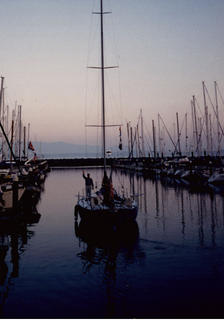 Only a few people were present on that still morning when we pulled out of Seattle to go see the world. Michael and JoAnne Grey, our neighbors at Shilshole Marina, who own Destiny; and Bill Baum was waiting out the marina entrance in his photo boat to get a shot for the local sailing mag. And my son Kenneth was there. That one surprised me. Ken hadn't said much to me about our leaving. He was sort of casual about the whole thing, so I didn't know he cared much, or even gave it a thought. But there he was that morning, arriving unannounced. He still didn't say much, just gave me a short hug and went back to his car. I guess he must have stayed there and watched us motor out, because JoAnne told me later she saw him still sitting in the car...with tears in his eyes. So that was the hardest part of going sailing, it turned out; leaving our family. Our friends were happy for us, and we were excited to be facing a new adventure, but the kids, who never had much of a dad when they needed him, now were going to have less of one. It's been hard for me too, being apart from my kids and grandchildren, not being a part of their lives. But I justified it by saying that we didn't see them that much when we were there, and I wasn't going to sit around the rest of my life waiting for them to make some time for grandpa. Still, it's been difficult. Still is. So I regret this, in a way. Its funny, the only things I really regret in my life have been the disappointments I brought to my family. Fred Roswold, SV WINGS Labels: Family, Pacific Coast, USA
|


 Mount Rainier
 Seattle Waterfront
 Ferry Boat
 La Conner
 Cottage Lake Gardens
 Tom & Kim
 Tom & Kim's house in North Bend

.jpg)


